Advertisements
Advertisements
प्रश्न
Find the coordinates of the image of the point (1, 6, 3) with respect to the line `vecr = (hatj + 2hatk) + λ(hati + 2hatj + 3hatk)`; where 'λ' is a scalar. Also, find the distance of the image from the y – axis.
Advertisements
उत्तर
Let P(1, 6, 3) be the given point, and let 'L' be the foot of the perpendicular from 'P' to the given line AB (as shown in the figure below). The coordinates of a general point on the given line are given by
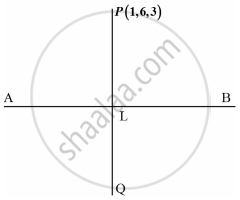
`(x - 0)/1 = (y - 1)/2 = (z - 2)/3` = λ; λ is a scalar, i.e., x = λ, y = 2λ + 1 and z = 3λ + 2
Let the coordinates of L be (λ, 2λ + 1, 3λ + 2).
So, direction ratios of PL are λ – 1, 2λ + 1 – 6 and 3λ + 2 – 3, i.e., λ – 1, 2λ – 5 and 3λ – 1.
Direction ratios of the given line are 1, 2 and 3, which is perpendicular to PL.
Therefore, (λ – 1)1 + (2λ – 5)2 + (3λ – 1)3 = 0
`\implies` 14λ – 14 = 0
`\implies` λ = 1
So, coordinates of L are (1, 3, 5).
Let Q(x1, y1, z1) be the image of P(1, 6, 3) in the given line.
Then, L is the mid-point of PQ.
Therefore, `((x_1 + 1))/2` = 1, `((y_1 + 6))/2` = 3 and `((z_1 + 3))/2` = 5
`\implies` x1 = 1, y1 = 0 and z1 = 7
Hence, the image of P(1, 6, 3) in the given line is (1, 0, 7).
Now, the distance of the point (1, 0, 7) from the y-axis is `sqrt(1^2 + 7^2) = sqrt(50)` units.
APPEARS IN
संबंधित प्रश्न
Find the direction cosines of the line
`(x+2)/2=(2y-5)/3; z=-1`
Direction cosines of the line passing through the points A (- 4, 2, 3) and B (1, 3, -2) are.........
Find the direction cosines of a line which makes equal angles with the coordinate axes.
Find the vector equation of the plane passing through (1, 2, 3) and perpendicular to the plane `vecr.(hati + 2hatj -5hatk) + 9 = 0`
Find the angle between the vectors whose direction cosines are proportional to 2, 3, −6 and 3, −4, 5.
Find the acute angle between the lines whose direction ratios are proportional to 2 : 3 : 6 and 1 : 2 : 2.
If the coordinates of the points A, B, C, D are (1, 2, 3), (4, 5, 7), (−4, 3, −6) and (2, 9, 2), then find the angle between AB and CD.
Find the angle between the lines whose direction cosines are given by the equations
l + 2m + 3n = 0 and 3lm − 4ln + mn = 0
Write the ratio in which YZ-plane divides the segment joining P (−2, 5, 9) and Q (3, −2, 4).
Write the distance of the point P (x, y, z) from XOY plane.
A rectangular parallelopiped is formed by planes drawn through the points (5, 7, 9) and (2, 3, 7) parallel to the coordinate planes. The length of an edge of this rectangular parallelopiped is
Find the equation of the lines passing through the point (2, 1, 3) and perpendicular to the lines
Verify whether the following ratios are direction cosines of some vector or not
`4/3, 0, 3/4`
If (a, a + b, a + b + c) is one set of direction ratios of the line joining (1, 0, 0) and (0, 1, 0), then find a set of values of a, b, c
If `vec"a" = 2hat"i" + 3hat"j" - 4hat"k", vec"b" = 3hat"i" - 4hat"j" - 5hat"k"`, and `vec"c" = -3hat"i" + 2hat"j" + 3hat"k"`, find the magnitude and direction cosines of `vec"a", vec"b", vec"c"`
If the direction ratios of a line are 1, 1, 2, find the direction cosines of the line.
The x-coordinate of a point on the line joining the points Q(2, 2, 1) and R(5, 1, –2) is 4. Find its z-coordinate.
A line makes equal angles with co-ordinate axis. Direction cosines of this line are ______.
If a line makes an angle of `pi/4` with each of y and z-axis, then the angle which it makes with x-axis is ______.
The area of the quadrilateral ABCD, where A(0,4,1), B(2, 3, –1), C(4, 5, 0) and D(2, 6, 2), is equal to ______.
Find the direction cosine of a line which makes equal angle with coordinate axes.
If a line has the direction ratio – 18, 12, – 4, then what are its direction cosine.
What will be the value of 'P' so that the lines `(1 - x)/3 = (7y - 14)/(2P) = (z - 3)/2` and `(7 - 7x)/(3P) = (y - 5)/1 = (6 - z)/5` at right angles.
The co-ordinates of the point where the line joining the points (2, –3, 1), (3, –4, –5) cuts the plane 2x + y + z = 7 are ______.
If two straight lines whose direction cosines are given by the relations l + m – n = 0, 3l2 + m2 + cnl = 0 are parallel, then the positive value of c is ______.
Equation of a line passing through point (1, 2, 3) and equally inclined to the coordinate axis, is ______.
