Advertisements
Advertisements
प्रश्न
Find the area of the quadrilateral whose vertices are at (– 9, – 2), (– 8, – 4), (2, 2) and (1, – 3)
Advertisements
उत्तर
Let the vertices A(– 9, – 2), B(– 8, – 4), C(2, 2) and D(1, – 3).
Plot the vertices in a graph.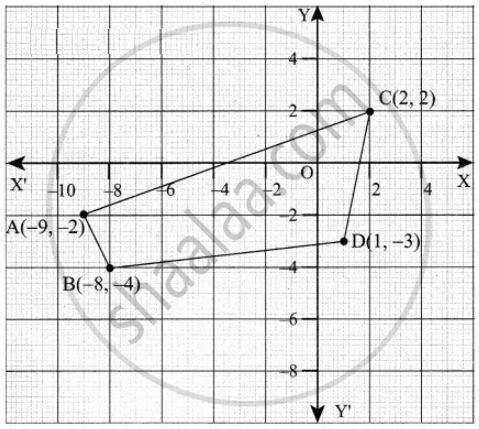
Note: Consider the points in counter clockwise order
Area of the Quadrilateral = `1/2[(x_1y_2 + x_2y_3 + x_3y_4 + x_4y_1) - (x_2y_1 + x_3y_2 + x_4y_3 + x_1y_4)]`
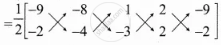
Area of the Quadrilateral ABDC = `1/2[36 + 24 + 2 - 4 - (16 - 4 - 6 - 18)]`
= `1/2[58 - (- 12)] - 1/2 [58 + 12]`
= `1/2 xx 70`
= 35 sq. units
∴ The area of the quadrilateral is 35 sq. units.
APPEARS IN
संबंधित प्रश्न
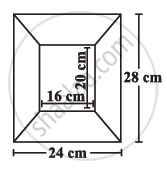
Diagram of the adjacent picture frame has outer dimensions = 24 cm × 28 cm and inner dimensions 16 cm × 20 cm. Find the area of each section of the frame, if the width of each section is same.
The diagonals of a quadrilateral are 16 cm and 13 cm. If they intersect each other at right angles; find the area of the quadrilateral.
The perimeter of a rhombus is 46 cm. If the height of the rhombus is 8 cm; find its area.
The perimeter of a rhombus is 52 cm. If one diagonal is 24 cm; find:
(i) The length of its other diagonal,
(ii) Its area.
The length of a rectangular verandah is 3 m more than its breadth. The numerical value of its area is equal to the numerical value of its perimeter.
(i) Taking x as the breadth of the verandah, write an equation in x that represents the above statement
(ii) Solve the equation obtained in (i) above and hence find the dimensions of the verandah.
The area of a rhombus is 216 sq. cm. If it's one diagonal is 24 cm; find:
(i) Length of its other diagonal,
(ii) Length of its side,
(iii) The perimeter of the rhombus.
Sum of the areas of two squares is 400 cm2. If the difference of their perimeters is 16 cm, find the sides of the two squares.
A quadrilateral field of unequal has a longer diagonal with 140m. The perpendiculars from opposite vertives upon this diagonal are 20m and 14m. Find the area of the field.
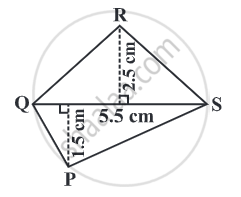
Find the area of quadrilateral PQRS.
In the following, find the value of ‘a’ for which the given points are collinear
(2, 3), (4, a) and (6, – 3)
