Advertisements
Advertisements
प्रश्न
Find the area of a right-angled triangle whose hypotenuse is 13 cm long and one of its legs is 12 cm long.
Advertisements
उत्तर
In right-angled Δ ABC,
Base BC = 12 cm
and hypotenuse AC = 13 cm
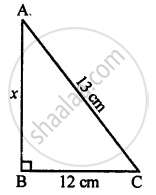
Applying Pythagoras Theorem,
(AC)2 = (AB)2 + (BC)2
(13)2 = (AB)2 + (12)2
169 = (AB)2 + 144
(AB)2 = 169 − 144
(AB)2 = 25
∴ AB =`sqrt25`
= `sqrt(5xx5)` = 5 cm
Now, area of Δ ABC =`1/2"base"xx"altitude"`
= `1/2xx12xx5` = 30 cm2
APPEARS IN
संबंधित प्रश्न
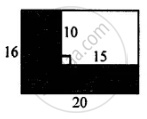
In the figure given below, find the area of shaded region: (All measurements are in cm)
The base of a parallelogram is thrice it height. If its area is 768 cm2, find the base and the height of the parallelogram.
Find the area of a triangle whose base is 30 cm and the height is 18 cm.
Find the area of an equilateral triangle whose each side is 16 cm. (Take `sqrt3`= 1.73)
The sides of a triangle are 21 cm, 17 cm, and 10 cm. Find its area.
Find the base of a triangle whose area is 360 cm2 and height is 24 cm.
The ratio between the radius of two circles is 5 : 7. Find the ratio between their:
(i) circumference
(ii) areas
The diameter of every wheel of a car is 63 cm. How much distance will the car move during the 2000 revolutions of its wheel.
A wire is along the boundary of a circle with a radius of 28 cm. If the same wire is bent in the form of a square, find the area of the square formed.
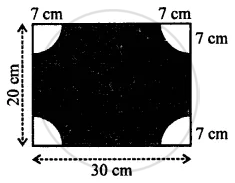
From each corner of a rectangular paper (30 cm x 20 cm) a quadrant of a circle of radius 7 cm is cut. Find the area of the remaining paper i.e., shaded portion.