Advertisements
Advertisements
प्रश्न
Find out my partner.
| Group 'A' | Group 'B' |
| 1. Heart beats | a. 350 ml |
| 2. RBC | b. 7.4 |
| 3. WBC | c. 37∘C |
| 4. Blood donation | d. 72 |
| 5. Normal body Temperature | e. 50-60 lakh/mm3 |
| 6. pH of oxygenated blood | f. 5000-6000 per mm3 |
Advertisements
उत्तर
| Group 'A' | Answer |
| 1. Heart beats | d. 72 |
| 2. RBC | e. 50-60 lakh/mm3 |
| 3 WBC | f. 5000-6000 per mm3 |
| 4 Blood donation | a. 350 ml |
| 5 Normal body Temperature | c. 37∘C |
| 6 pH of oxygenated blood | b. 7.4 |
संबंधित प्रश्न
Give appropriate biological or technical terms for the following
The relaxation phase of the heart.
A blood vessel which has small lumen and thick wall is ______.
Differentiate between members of the following pairs with reference to the aspect asked within bracket:
Artery and vein (direction of blood flow)
Given below is a highly schematic diagram of the human blood circulatory system.
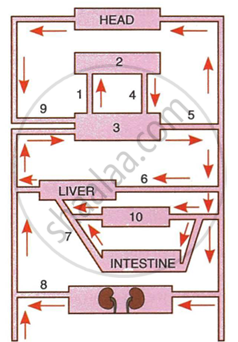 |
- Which part (state the number) represents the heart? Give reason in support of your answer.
- Which numbers represent the following, respectively?
Aorta Superior vena cava Hepatic portal vein Renal Vein Pulmonary artery Stomach
Explain the structure and function of human blood.
Production of RBCs occurs in ______.
Name the main parts of the circulatory system
Veins have valves at intervals in their inner lining whereas the arteries do not have valves. Explain.
Given below is the simplified pathway of the circulatory system:
(i) Name the blood vessels marked 1 to 8.
(ii) Name the chamber of the heart which:
(a) Receives blood from ‘1’.
(b) Pumps blood into blood vessel ‘8’.
(iii) Mention two structural differences between blood vessels ‘7’ and ‘2’.
Name these:
Two kinds of circulatory systems in different animals.
