Advertisements
Advertisements
प्रश्न
Given below is a highly schematic diagram of the human blood circulatory system.
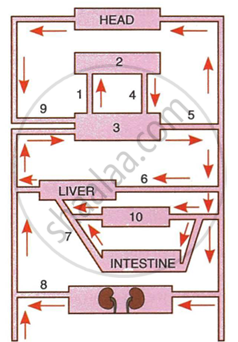 |
- Which part (state the number) represents the heart? Give reason in support of your answer.
- Which numbers represent the following, respectively?
Aorta Superior vena cava Hepatic portal vein Renal Vein Pulmonary artery Stomach
Advertisements
उत्तर
- Number 3 The diagram shows the heart by showing the flow of blood from the same number and ending in the second section from all sides, representing both the supplier and collecting vessel.
- Aorta - 5
Hepatic portal vein - 7
Pulmonary artery - 1
Superior vena cava - 9
Renal Vein - 8
Stomach - 10
APPEARS IN
संबंधित प्रश्न
the Biological/technical term for The vein which drains the blood from the intestine to the liver.
Why is it necessary to know the blood groups before giving transfusion?
what is Lymph nodes?
How do you account for the following difference?
The left ventricle has thicker walls than the right ventricle.
Put a tick mark (✓) against the correct alternative in the following statement.
The blood tastes saltish due to the dissolved.
Blood consists of two parts - a liquid part and a cellular part. Name these parts and briefly write about them
Describe the functions of the: Heart
What are seen as greenish blue lines in our hands and legs?
______ WBCs are present per mm3 of blood.
Ventricles have ______ walls when compared with those of auricles.
