Advertisements
Advertisements
प्रश्न
Given below is a highly schematic diagram of the human blood circulatory system.
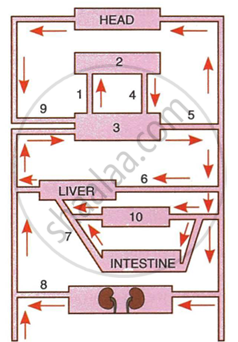 |
- Which part (state the number) represents the heart? Give reason in support of your answer.
- Which numbers represent the following, respectively?
Aorta Superior vena cava Hepatic portal vein Renal Vein Pulmonary artery Stomach
Advertisements
उत्तर
- Number 3 The diagram shows the heart by showing the flow of blood from the same number and ending in the second section from all sides, representing both the supplier and collecting vessel.
- Aorta - 5
Hepatic portal vein - 7
Pulmonary artery - 1
Superior vena cava - 9
Renal Vein - 8
Stomach - 10
APPEARS IN
संबंधित प्रश्न
The blood from the heart is transported to all parts of the body by the ______.
Describe the circulatory system of humans.
Name the following:
Any one vein which starts from an organ and ends in another organ besides the heart
Give reason for the following:
The blood groups of both the donor and recipient must be known before transfusing blood.
Blood consists of two parts - a liquid part and a cellular part. Name these parts and briefly write about them
Fill in the blank:
______ carry pure blood.
Why is a person having blood group AB called universal recipient and a person with blood group O called a universal donor?
Which of the following is TRUE regarding closed circulatory system?
Identify the normal haemoglobin count in human females.
A resting person usually has a pulse rate between 72 to 80 beats per minute.
