Advertisements
Advertisements
प्रश्न
Find one-parameter families of solution curves of the following differential equation:-
\[\left( x + y \right)\frac{dy}{dx} = 1\]
Solve the following differential equation:-
\[\left( x + y \right)\frac{dy}{dx} = 1\]
Advertisements
उत्तर
We have,
\[\left( x + y \right)\frac{dy}{dx} = 1\]
\[ \Rightarrow \frac{dy}{dx} = \frac{1}{x + y}\]
\[ \Rightarrow \frac{dx}{dy} = x + y\]
\[ \Rightarrow \frac{dx}{dy} - x = y . . . . . \left( 1 \right)\]
Clearly, it is a linear differential equation of the form
\[\frac{dx}{dy} + Px = Q\]
where
\[P = - 1\]
\[Q = y\]
\[ \therefore I . F . = e^{\int P\ dy} \]
\[ = e^{\int - 1 dy} \]
\[ = e^{- y} \]
\[\text{ Multiplying both sides of }(1)\text{ by }e^{- y} ,\text{ we get }\]
\[ e^{- y} \left( \frac{dx}{dy} - x \right) = e^{- y} y\]
\[ \Rightarrow e^{- y} \frac{dx}{dy} - e^{- y} x = e^{- y} y\]
Integrating both sides with respect to y, we get
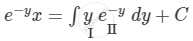
\[ \Rightarrow e^{- y} x = y\int e^{- y} dy - \int\left[ \frac{d}{dy}\left( y \right)\int e^{- y} dy \right]dy + C\]
\[ \Rightarrow e^{- y} x = - y e^{- y} - e^{- y} + C\]
\[ \Rightarrow e^{- y} x + y e^{- y} + e^{- y} = C\]
\[ \Rightarrow \left( x + y + 1 \right) e^{- y} = C\]
\[ \Rightarrow \left( x + y + 1 \right) = C e^y \]
\[\text{ Hence, }\left( x + y + 1 \right) = C e^y\text{ is the required solution.}\]
APPEARS IN
संबंधित प्रश्न
Form the differential equation representing the family of curves given by (x – a)2 + 2y2 = a2, where a is an arbitrary constant.
Form the differential equation of the family of circles in the first quadrant which touch the coordinate axes.
Form the differential equation from the following primitive where constants are arbitrary:
y2 = 4ax
Form the differential equation from the following primitive where constants are arbitrary:
xy = a2
Find the differential equation of the family of curves, x = A cos nt + B sin nt, where A and B are arbitrary constants.
Form the differential equation corresponding to (x − a)2 + (y − b)2 = r2 by eliminating a and b.
Form the differential equation of the family of curves represented by the equation (a being the parameter):
(2x − a)2 − y2 = a2
Form the differential equation of the family of curves represented by the equation (a being the parameter):
(x − a)2 + 2y2 = a2
Represent the following families of curves by forming the corresponding differential equations (a, b being parameters):
(x − a)2 − y2 = 1
Represent the following families of curves by forming the corresponding differential equations (a, b being parameters):
y = ax3
Represent the following families of curves by forming the corresponding differential equations (a, b being parameters):
x2 + y2 = ax3
Find the equation of a curve passing through the point (0, 0) and whose differential equation is \[\frac{dy}{dx} = e^x \sin x\]
Find one-parameter families of solution curves of the following differential equation:-
\[\frac{dy}{dx} - y = \cos 2x\]
Find one-parameter families of solution curves of the following differential equation:-
\[x\frac{dy}{dx} - y = \left( x + 1 \right) e^{- x}\]
Find one-parameter families of solution curves of the following differential equation:-
\[x\frac{dy}{dx} + y = x^4\]
Find one-parameter families of solution curves of the following differential equation:-
\[\left( x \log x \right)\frac{dy}{dx} + y = \log x\]
Find one-parameter families of solution curves of the following differential equation:-
\[\frac{dy}{dx} - \frac{2xy}{1 + x^2} = x^2 + 2\]
Find one-parameter families of solution curves of the following differential equation:-
\[\frac{dy}{dx} + y \cos x = e^{\sin x} \cos x\]
The family of curves in which the sub tangent at any point of a curve is double the abscissae, is given by
Form the differential equation representing the family of curves `y2 = m(a2 - x2) by eliminating the arbitrary constants 'm' and 'a'.
Find the area of the region bounded by the curves (x -1)2 + y2 = 1 and x2 + y2 = 1, using integration.
Form the differential equation representing the family of curves y = e2x (a + bx), where 'a' and 'b' are arbitrary constants.
Find the equation of a curve whose tangent at any point on it, different from origin, has slope `y + y/x`.
The solution of the differential equation `2x * "dy"/"dx" y` = 3 represents a family of ______.
Form the differential equation by eliminating A and B in Ax2 + By2 = 1
Family y = Ax + A3 of curves is represented by the differential equation of degree ______.
Family y = Ax + A3 of curves will correspond to a differential equation of order ______.
The differential equation of the family of curves y2 = 4a(x + a) is ______.
The differential equation representing the family of circles x2 + (y – a)2 = a2 will be of order two.
The area above the x-axis and under the curve `y = sqrt(1/x - 1)` for `1/2 ≤ x ≤ 1` is:
From the differential equation of the family of circles touching the y-axis at origin
