Advertisements
Advertisements
प्रश्न
Find the foot of the perpendicular drawn from the point A (1, 0, 3) to the joint of the points B (4, 7, 1) and C (3, 5, 3).
Advertisements
उत्तर
Let D be the foot of the perpendicular drawn from the point A (1, 0, 3) to the line BC.
The coordinates of a general point on the line BC are given by
\[\frac{x - 4}{4 - 3} = \frac{y - 7}{7 - 5} = \frac{z - 1}{1 - 3} = \lambda\]
\[ \Rightarrow x = \lambda + 4\]
\[ y = 2\lambda + 7 \]
\[ z = - 2\lambda + 1\]
Let the coordinates of D be
\[\left( \lambda + 4, 2\lambda + 7, - 2\lambda + 1 \right)\]
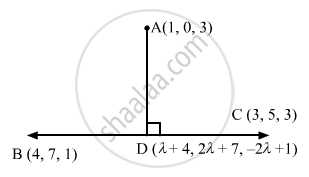
The direction ratios of AD are proportional to
\[\lambda + 4 - 1, 2\lambda + 7 - 0, - 2\lambda + 1 - 3, i . e . \lambda + 3, 2\lambda + 7, - 2\lambda - 2\]
The direction ratios of the line BC are proportional to 1, 2,-2, but AD is perpendicular to the line BC.
\[\therefore 1\left( \lambda + 3 \right) + 2\left( 2\lambda + 7 \right) - 2\left( - 2\lambda - 2 \right) = 0\]
\[ \Rightarrow \lambda = - \frac{7}{3}\]
Substituting
\[ \Rightarrow \lambda = - \frac{7}{3}\] in
\[\left( \lambda + 4, 2\lambda + 7, - 2\lambda + 1 \right)\] we get the coordinates of D as \[\left( \frac{5}{3}, \frac{7}{3}, \frac{17}{3} \right)\] .
APPEARS IN
संबंधित प्रश्न
If a line drawn from the point A( 1, 2, 1) is perpendicular to the line joining P(1, 4, 6) and Q(5, 4, 4) then find the co-ordinates of the foot of the perpendicular.
Find the equation of the line in vector and in Cartesian form that passes through the point with position vector `2hati -hatj+4hatk` and is in the direction `hati + 2hatj - hatk`.
Find the vector and the Cartesian equations of the lines that pass through the origin and (5, −2, 3).
Find the vector equation of a line which is parallel to the vector \[2 \hat{i} - \hat{j} + 3 \hat{k}\] and which passes through the point (5, −2, 4). Also, reduce it to cartesian form.
The cartesian equations of a line are x = ay + b, z = cy + d. Find its direction ratios and reduce it to vector form.
The cartesian equation of a line are 3x + 1 = 6y − 2 = 1 − z. Find the fixed point through which it passes, its direction ratios and also its vector equation.
Show that the three lines with direction cosines \[\frac{12}{13}, \frac{- 3}{13}, \frac{- 4}{13}; \frac{4}{13}, \frac{12}{13}, \frac{3}{13}; \frac{3}{13}, \frac{- 4}{13}, \frac{12}{13}\] are mutually perpendicular.
Show that the line joining the origin to the point (2, 1, 1) is perpendicular to the line determined by the points (3, 5, −1) and (4, 3, −1).
Find the angle between the following pair of line:
\[\overrightarrow{r} = \left( 3 \hat{i} + 2 \hat{j} - 4 \hat{k} \right) + \lambda\left( \hat{i} + 2 \hat{j} + 2 \hat{k} \right) \text{ and } \overrightarrow{r} = \left( 5 \hat{j} - 2 \hat{k} \right) + \mu\left( 3 \hat{i} + 2 \hat{j} + 6 \hat{k} \right)\]
Find the angle between the following pair of line:
\[\frac{x - 1}{2} = \frac{y - 2}{3} = \frac{z - 3}{- 3} \text { and } \frac{x + 3}{- 1} = \frac{y - 5}{8} = \frac{z - 1}{4}\]
Find the angle between the following pair of line:
\[\frac{x - 2}{3} = \frac{y + 3}{- 2}, z = 5 \text{ and } \frac{x + 1}{1} = \frac{2y - 3}{3} = \frac{z - 5}{2}\]
Find the angle between the following pair of line:
\[\frac{x - 5}{1} = \frac{2y + 6}{- 2} = \frac{z - 3}{1} \text{ and } \frac{x - 2}{3} = \frac{y + 1}{4} = \frac{z - 6}{5}\]
Find the equations of the line passing through the point (−1, 2, 1) and parallel to the line \[\frac{2x - 1}{4} = \frac{3y + 5}{2} = \frac{2 - z}{3} .\]
Find the equations of the line passing through the point (2, 1, 3) and perpendicular to the lines \[\frac{x - 1}{1} = \frac{y - 2}{2} = \frac{z - 3}{3} \text{ and } \frac{x}{- 3} = \frac{y}{2} = \frac{z}{5}\]
Determine the equations of the line passing through the point (1, 2, −4) and perpendicular to the two lines \[\frac{x - 8}{8} = \frac{y + 9}{- 16} = \frac{z - 10}{7} \text{ and } \frac{x - 15}{3} = \frac{y - 29}{8} = \frac{z - 5}{- 5}\]
Find the value of λ so that the following lines are perpendicular to each other. \[\frac{x - 5}{5\lambda + 2} = \frac{2 - y}{5} = \frac{1 - z}{- 1}, \frac{x}{1} = \frac{2y + 1}{4\lambda} = \frac{1 - z}{- 3}\]
Find the length of the perpendicular drawn from the point (5, 4, −1) to the line \[\overrightarrow{r} = \hat{i} + \lambda\left( 2 \hat{i} + 9 \hat{j} + 5 \hat{k} \right) .\]
Find the foot of the perpendicular from (0, 2, 7) on the line \[\frac{x + 2}{- 1} = \frac{y - 1}{3} = \frac{z - 3}{- 2} .\]
Find the coordinates of the foot of perpendicular drawn from the point A(1, 8, 4) to the line joining the points B(0, −1, 3) and C(2, −3, −1).
Find the shortest distance between the following pairs of lines whose vector equations are: \[\overrightarrow{r} = \left( 2 \hat{i} - \hat{j} - \hat{k} \right) + \lambda\left( 2 \hat{i} - 5 \hat{j} + 2 \hat{k} \right) \text{ and }, \overrightarrow{r} = \left( \hat{i} + 2 \hat{j} + \hat{k} \right) + \mu\left( \hat{i} - \hat{j} + \hat{k} \right)\]
Find the shortest distance between the following pairs of lines whose vector equations are: \[\overrightarrow{r} = \left( 8 + 3\lambda \right) \hat{i} - \left( 9 + 16\lambda \right) \hat{j} + \left( 10 + 7\lambda \right) \hat{k} \]\[\overrightarrow{r} = 15 \hat{i} + 29 \hat{j} + 5 \hat{k} + \mu\left( 3 \hat{i} + 8 \hat{j} - 5 \hat{k} \right)\]
By computing the shortest distance determine whether the following pairs of lines intersect or not: \[\overrightarrow{r} = \left( \hat{i} + \hat{j} - \hat{k} \right) + \lambda\left( 3 \hat{i} - \hat{j} \right) \text{ and } \overrightarrow{r} = \left( 4 \hat{i} - \hat{k} \right) + \mu\left( 2 \hat{i} + 3 \hat{k} \right)\]
Find the equations of the lines joining the following pairs of vertices and then find the shortest distance between the lines
(i) (0, 0, 0) and (1, 0, 2)
Write the cartesian and vector equations of Z-axis.
Write the angle between the lines \[\frac{x - 5}{7} = \frac{y + 2}{- 5} = \frac{z - 2}{1} \text{ and } \frac{x - 1}{1} = \frac{y}{2} = \frac{z - 1}{3} .\]
Write the angle between the lines 2x = 3y = −z and 6x = −y = −4z.
Write the value of λ for which the lines \[\frac{x - 3}{- 3} = \frac{y + 2}{2\lambda} = \frac{z + 4}{2} \text{ and } \frac{x + 1}{3\lambda} = \frac{y - 2}{1} = \frac{z + 6}{- 5}\] are perpendicular to each other.
Find the angle between the lines
\[\vec{r} = \left( 2 \hat{i} - 5 \hat{j} + \hat{k} \right) + \lambda\left( 3 \hat{i} + 2 \hat{j} + 6 \hat{k} \right)\] and \[\vec{r} = 7 \hat{i} - 6 \hat{k} + \mu\left( \hat{i} + 2 \hat{j} + 2 \hat{k} \right)\]
Find the angle between the lines 2x=3y=-z and 6x =-y=-4z.
The straight line \[\frac{x - 3}{3} = \frac{y - 2}{1} = \frac{z - 1}{0}\] is
Find the equation of a plane which passes through the point (3, 2, 0) and contains the line \[\frac{x - 3}{1} = \frac{y - 6}{5} = \frac{z - 4}{4}\].
Find the value of λ for which the following lines are perpendicular to each other:
`(x - 5)/(5 lambda + 2 ) = ( 2 - y )/5 = (1 - z ) /-1 ; x /1 = ( y + 1/2)/(2 lambda ) = ( z -1 ) / 3`
Auxillary equation of 2x2 + 3xy − 9y2 = 0 is ______
The equation of line passing through (3, -1, 2) and perpendicular to the lines `overline("r")=(hat"i"+hat"j"-hat"k")+lambda(2hat"i"-2hat"j"+hat"k")` and `overline("r")=(2hat"i"+hat"j"-3hat"k")+mu(hat"i"-2hat"j"+2hat"k")` is ______.
In the vector equation \[\vec{r}=\vec{a}+\lambda\vec{b}\], what does \[\vec{r}\] represent?
A line passes through \[(5,2,-4)\] and is parallel to \[3\hat{i}+2\hat{j}-8\hat{k}\]. Which is its vector equation?
