Advertisements
Advertisements
प्रश्न
Find the equations to the straight lines which go through the origin and trisect the portion of the straight line 3 x + y = 12 which is intercepted between the axes of coordinates.
Advertisements
उत्तर
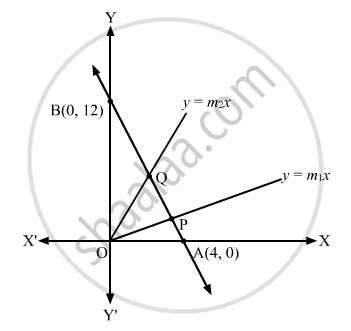
Let the line 3x + y = 12 intersect the x-axis and the y-axis at A and B, respectively.
At x = 0
0 + y = 12
\[\Rightarrow\] y = 12
At y = 0
3x + 0 = 12
\[\Rightarrow\] x = 4
\[\therefore A \equiv \left( 4, 0 \right) \text{and } B \equiv \left( 0, 12 \right)\]
Let
\[y = m_1 x \text { and } y = m_2 x\] be the lines that pass through the origin and trisect the line 3x + y = 12 at P and Q.
∴ AP = PQ = QB
Let us find the coordinates of P and Q.
\[P \equiv \left( \frac{2 \times 4 + 1 \times 0}{2 + 1}, \frac{2 \times 0 + 1 \times 12}{2 + 1} \right) \equiv \left( \frac{8}{3}, 4 \right)\]
\[Q \equiv \left( \frac{1 \times 4 + 2 \times 0}{2 + 1}, \frac{1 \times 0 + 2 \times 12}{2 + 1} \right) \equiv \left( \frac{4}{3}, 8 \right)\]
Clearly, P and Q lie on \[y = m_1 x \text { and } y = m_2 x\] ,respectively.
\[\therefore 4 = m_1 \times \frac{8}{3} \text { and }8 = m_2 \times \frac{4}{3}\]
\[ \Rightarrow m_1 = \frac{3}{2} \text { and} m_2 = 6\]
Hence, the required lines are
\[y = \frac{3}{2}x \Rightarrow 2y = 3x \text { and } y = 6x\]
APPEARS IN
संबंधित प्रश्न
Draw the lines x = − 3, x = 2, y = − 2, y = 3 and write the coordinates of the vertices of the square so formed.
Find the equation of the straight line passing through the point (6, 2) and having slope − 3.
Find the equation of the line passing through (0, 0) with slope m.
Find the equation of the straight line passing through (3, −2) and making an angle of 60° with the positive direction of y-axis.
Find the equation of the line passing through the point (−3, 5) and perpendicular to the line joining (2, 5) and (−3, 6).
Find the equation of the straight lines passing through the following pair of point :
(0, 0) and (2, −2)
Find the equation of the straight lines passing through the following pair of point:
(a, b) and (a + c sin α, b + c cos α)
Find the equation of the straight lines passing through the following pair of point :
(at1, a/t1) and (at2, a/t2)
Find the equation of the straight lines passing through the following pair of point :
(a cos α, a sin α) and (a cos β, a sin β)
Find the equations of the medians of a triangle, the coordinates of whose vertices are (−1, 6), (−3, −9) and (5, −8).
Find the equation to the straight line cutting off intercepts 3 and 2 from the axes.
Find the equation to the straight line cutting off intercepts − 5 and 6 from the axes.
Find the equation to the straight line which passes through the point (5, 6) and has intercepts on the axes
(i) equal in magnitude and both positive,
(ii) equal in magnitude but opposite in sign.
Find the equation of the line which passes through the point (3, 4) and is such that the portion of it intercepted between the axes is divided by the point in the ratio 2:3.
Find the equations of the straight lines which pass through the origin and trisect the portion of the straight line 2x + 3y = 6 which is intercepted between the axes.
A line is such that its segment between the straight lines 5x − y − 4 = 0 and 3x + 4y − 4 = 0 is bisected at the point (1, 5). Obtain its equation.
Three sides AB, BC and CA of a triangle ABC are 5x − 3y + 2 = 0, x − 3y − 2 = 0 and x + y − 6 = 0 respectively. Find the equation of the altitude through the vertex A.
Find the equation of the line passing through the intersection of the lines 2x + y = 5 and x + 3y + 8 = 0 and parallel to the line 3x + 4y = 7.
Find the equation of the straight line passing through the point of intersection of the lines 5x − 6y − 1 = 0 and 3x + 2y + 5 = 0 and perpendicular to the line 3x − 5y + 11 = 0 .
Find the equation of a line passing through (3, −2) and perpendicular to the line x − 3y + 5 = 0.
Find the length of the perpendicular from the origin to the straight line joining the two points whose coordinates are (a cos α, a sin α) and (a cos β, a sin β).
Find the distance of the point (1, 2) from the straight line with slope 5 and passing through the point of intersection of x + 2y = 5 and x − 3y = 7.
Find the equation of the straight lines passing through the origin and making an angle of 45° with the straight line \[\sqrt{3}x + y = 11\].
Find the equations to the straight lines which pass through the origin and are inclined at an angle of 75° to the straight line \[x + y + \sqrt{3}\left( y - x \right) = a\].
Two sides of an isosceles triangle are given by the equations 7x − y + 3 = 0 and x + y − 3 = 0 and its third side passes through the point (1, −10). Determine the equation of the third side.
Write the area of the triangle formed by the coordinate axes and the line (sec θ − tan θ) x + (sec θ + tan θ) y = 2.
If the diagonals of the quadrilateral formed by the lines l1x + m1y + n1 = 0, l2x + m2y + n2 = 0, l1x + m1y + n1' = 0 and l2x + m2y + n2' = 0 are perpendicular, then write the value of l12 − l22 + m12 − m22.
If a, b, c are in G.P. write the area of the triangle formed by the line ax + by + c = 0 with the coordinates axes.
If a, b, c are in A.P., then the line ax + by + c = 0 passes through a fixed point. Write the coordinates of that point.
Find the locus of the mid-points of the portion of the line x sinθ+ y cosθ = p intercepted between the axes.
The equation of the straight line which passes through the point (−4, 3) such that the portion of the line between the axes is divided internally by the point in the ratio 5 : 3 is
A line passes through the point (2, 2) and is perpendicular to the line 3x + y = 3. Its y-intercept is
If a + b + c = 0, then the family of lines 3ax + by + 2c = 0 pass through fixed point
The equation of the line passing through (1, 5) and perpendicular to the line 3x − 5y + 7 = 0 is
Find the equation of the line passing through the point of intersection of 2x + y = 5 and x + 3y + 8 = 0 and parallel to the line 3x + 4y = 7.
The equations of the lines which pass through the point (3, –2) and are inclined at 60° to the line `sqrt(3) x + y` = 1 is ______.
The equation of the line joining the point (3, 5) to the point of intersection of the lines 4x + y – 1 = 0 and 7x – 3y – 35 = 0 is equidistant from the points (0, 0) and (8, 34).
The lines ax + 2y + 1 = 0, bx + 3y + 1 = 0 and cx + 4y + 1 = 0 are concurrent if a, b, c are in G.P.
