Advertisements
Advertisements
प्रश्न
Find the equation of straight line passing through (−2, −7) and having an intercept of length 3 between the straight lines 4x + 3y = 12 and 4x + 3y = 3.
Advertisements
उत्तर
Here,
\[\left( x_1 , y_1 \right) = A\left( - 2, - 7 \right)\]
So, the equation of the line is
\[\frac{x - x_1}{cos\theta} = \frac{y - y_1}{sin\theta}\]
\[ \Rightarrow \frac{x + 2}{cos\theta} = \frac{y + 7}{sin\theta}\]
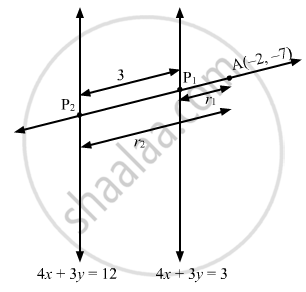
Let the required line intersect the lines 4x + 3y = 3 and 4x + 3y = 12 at P1 and P2.
Let AP1 = r1 and AP2 = r2
Then, the coordinates of P1 and P2 are given by
\[\frac{x - x_1}{cos\theta} = \frac{y - y_1}{sin\theta}={r_1}\] and \[ \Rightarrow \frac{x + 2}{cos\theta} = \frac{y + 7}{sin\theta}= {r_2}\], respectively.
Thus, the coordinates of P1 and P2 are \[\left( - 2 + r_1 cos\theta, - 7 + r_1 sin\theta \right) \text { and } \left( - 2 + r_2 cos\theta, - 7 + r_2 sin\theta \right)\], respectively.
Clearly, the points P1 and P2 lie on the lines 4x + 3y = 3 and 4x + 3y = 12
\[4\left( - 2 + r_1 cos\theta \right) + 3\left( - 7 + r_1 sin\theta \right) = 3 and 4\left( - 2 + r_2 cos\theta \right) + 3\left( - 7 + r_2 sin\theta \right) = 12\]
\[ \Rightarrow r_1 = \frac{32}{4cos\theta + 3sin\theta} \text { and } r_2 = \frac{41}{4cos\theta + 3sin\theta}\]
\[\text { Here }, A P_2 - A P_1 = 3 \Rightarrow r_2 - r_1 = 3\]
\[ \Rightarrow \frac{41}{4cos\theta + 3sin\theta} - \frac{32}{4cos\theta + 3sin\theta} = 3\]
\[ \Rightarrow 3 = 4cos\theta + 3sin\theta\]
\[ \Rightarrow 3\left( 1 - sin\theta \right) = 4cos\theta\]
\[ \Rightarrow 9\left( 1 + \sin^2 \theta - 2sin\theta \right) = 16 \cos^2 \theta = 16\left( 1 - \sin^2 \theta \right)\]
\[ \Rightarrow 25 \sin^2 \theta - 18sin\theta - 7 = 0\]
\[ \Rightarrow \left( sin\theta - 1 \right)\left( 25sin\theta + 7 \right) = 0\]
\[ \Rightarrow sin\theta = 1, sin\theta = - \frac{7}{25}\]
\[ \Rightarrow cos\theta = 0, cos\theta = \frac{24}{25}\]
Thus, the equation of the required line is
\[x + 2 = 0\text { or } \frac{x + 2}{\frac{24}{25}} = \frac{y + 7}{\frac{- 7}{25}}\]
\[ \Rightarrow x + 2 = 0 \text { or } 7x + 24y + 182 = 0\]
APPEARS IN
संबंधित प्रश्न
Find the equation of the line perpendicular to x-axis and having intercept − 2 on x-axis.
Draw the lines x = − 3, x = 2, y = − 2, y = 3 and write the coordinates of the vertices of the square so formed.
Find the equation of the straight line passing through the point (6, 2) and having slope − 3.
Find the equation of the line passing through \[(2, 2\sqrt{3})\] and inclined with x-axis at an angle of 75°.
Find the equation of the straight line which divides the join of the points (2, 3) and (−5, 8) in the ratio 3 : 4 and is also perpendicular to it.
Prove that the perpendicular drawn from the point (4, 1) on the join of (2, −1) and (6, 5) divides it in the ratio 5 : 8.
Find the equation of the straight lines passing through the following pair of point :
(0, 0) and (2, −2)
Find the equation of the straight lines passing through the following pair of point:
(a, b) and (a + c sin α, b + c cos α)
Find the equation of the straight lines passing through the following pair of point :
(a, b) and (a + b, a − b)
Find the equation of the straight lines passing through the following pair of point :
(a cos α, a sin α) and (a cos β, a sin β)
Find the equations of the sides of the triangles the coordinates of whose angular point is respectively (0, 1), (2, 0) and (−1, −2).
Find the equations of the medians of a triangle, the coordinates of whose vertices are (−1, 6), (−3, −9) and (5, −8).
By using the concept of equation of a line, prove that the three points (−2, −2), (8, 2) and (3, 0) are collinear.
Find the equation to the straight line cutting off intercepts 3 and 2 from the axes.
Find the equations of the straight lines each of which passes through the point (3, 2) and cuts off intercepts a and b respectively on X and Y-axes such that a − b = 2.
A straight line drawn through the point A (2, 1) making an angle π/4 with positive x-axis intersects another line x + 2y + 1 = 0 in the point B. Find length AB.
If the straight line \[\frac{x}{a} + \frac{y}{b} = 1\] passes through the point of intersection of the lines x + y = 3 and 2x − 3y = 1 and is parallel to x − y − 6 = 0, find a and b.
Find the equation of the straight line through the point (α, β) and perpendicular to the line lx + my + n = 0.
Find the length of the perpendicular from the point (4, −7) to the line joining the origin and the point of intersection of the lines 2x − 3y + 14 = 0 and 5x + 4y − 7 = 0.
Find the equations of the straight lines passing through (2, −1) and making an angle of 45° with the line 6x + 5y − 8 = 0.
Find the equations of the two straight lines through (1, 2) forming two sides of a square of which 4x+ 7y = 12 is one diagonal.
Find the equation of the straight line drawn through the point of intersection of the lines x + y = 4 and 2x − 3y = 1 and perpendicular to the line cutting off intercepts 5, 6 on the axes.
Show that the straight lines given by (2 + k) x + (1 + k) y = 5 + 7k for different values of k pass through a fixed point. Also, find that point.
Find the equation of the straight line which passes through the point of intersection of the lines 3x − y = 5 and x + 3y = 1 and makes equal and positive intercepts on the axes.
If the diagonals of the quadrilateral formed by the lines l1x + m1y + n1 = 0, l2x + m2y + n2 = 0, l1x + m1y + n1' = 0 and l2x + m2y + n2' = 0 are perpendicular, then write the value of l12 − l22 + m12 − m22.
Write the integral values of m for which the x-coordinate of the point of intersection of the lines y = mx + 1 and 3x + 4y = 9 is an integer.
If a, b, c are in A.P., then the line ax + by + c = 0 passes through a fixed point. Write the coordinates of that point.
The equation of the straight line which passes through the point (−4, 3) such that the portion of the line between the axes is divided internally by the point in the ratio 5 : 3 is
A line passes through the point (2, 2) and is perpendicular to the line 3x + y = 3. Its y-intercept is
If a + b + c = 0, then the family of lines 3ax + by + 2c = 0 pass through fixed point
The inclination of the straight line passing through the point (−3, 6) and the mid-point of the line joining the point (4, −5) and (−2, 9) is
The equation of the line passing through the point (1, 2) and perpendicular to the line x + y + 1 = 0 is ______.
The equations of the lines which pass through the point (3, –2) and are inclined at 60° to the line `sqrt(3) x + y` = 1 is ______.
If a, b, c are in A.P., then the straight lines ax + by + c = 0 will always pass through ______.
Equation of the line passing through the point (a cos3θ, a sin3θ) and perpendicular to the line x sec θ + y cosec θ = a is x cos θ – y sin θ = a sin 2θ.
The straight line 5x + 4y = 0 passes through the point of intersection of the straight lines x + 2y – 10 = 0 and 2x + y + 5 = 0.
The lines ax + 2y + 1 = 0, bx + 3y + 1 = 0 and cx + 4y + 1 = 0 are concurrent if a, b, c are in G.P.
