Advertisements
Advertisements
प्रश्न
Find the equations to the altitudes of the triangle whose angular points are A (2, −2), B (1, 1) and C (−1, 0).
Advertisements
उत्तर
Let \[m_{AD} , m_{BE} \text { and } m_{CF}\] be the slopes of the altitudes AD, BE and CF, respectively.
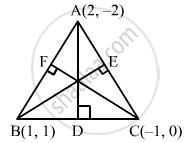
\[\therefore\text { Slope of AD } \times \text { Slope of BC } = - 1\]
\[ \Rightarrow m_{AD} \times \left( \frac{0 - 1}{- 1 - 1} \right) = - 1\]
\[ \Rightarrow m_{AD} \times \frac{1}{2} = - 1\]
\[ \Rightarrow m_{AD} = - 2\]
\[\text { Slope of BE } \times \text { Slope of AC } = - 1\]
\[ \Rightarrow m_{BE} \times \left( \frac{0 + 2}{- 1 - 2} \right) = - 1\]
\[ \Rightarrow m_{BE} \times \left( \frac{- 2}{3} \right) = - 1\]
\[ \Rightarrow m_{BE} = \frac{3}{2}\]
\[\text { Slope of CF } \times \text { Slope of AB } = - 1\]
\[ \Rightarrow m_{CF} \times \left( \frac{1 + 2}{1 - 2} \right) = - 1\]
\[ \Rightarrow m_{CF} \times \left( - 3 \right) = - 1\]
\[ \Rightarrow m_{CF} = \frac{1}{3}\]
Now, the equation of AD which passes through A (2, −2) and has slope −2 is
\[y + 2 = - 2\left( x - 2 \right)\]
\[ \Rightarrow 2x + y - 2 = 0\]
The equation of BE, which passes through B (1, 1) and has slope \[\frac{3}{2}\] is
\[y - 1 = \frac{3}{2}\left( x - 1 \right)\]
\[ \Rightarrow 3x - 2y - 1 = 0\]
The equation of CF, which passes through C (−1, 0) and has slope \[\frac{1}{3}\] is
\[y - 0 = \frac{1}{3}\left( x + 1 \right)\]
\[ \Rightarrow x - 3y + 1 = 0\]
APPEARS IN
संबंधित प्रश्न
Find the equation of the line parallel to x-axis and having intercept − 2 on y-axis.
Draw the lines x = − 3, x = 2, y = − 2, y = 3 and write the coordinates of the vertices of the square so formed.
Find the equations of the straight lines which pass through (4, 3) and are respectively parallel and perpendicular to the x-axis.
Find the equation of the straight line passing through (−2, 3) and inclined at an angle of 45° with the x-axis.
Find the equation of the line passing through the point (−3, 5) and perpendicular to the line joining (2, 5) and (−3, 6).
Find the equation of the straight lines passing through the following pair of point :
(0, 0) and (2, −2)
Find the equation of the straight lines passing through the following pair of point :
(a cos α, a sin α) and (a cos β, a sin β)
Find the equations to the diagonals of the rectangle the equations of whose sides are x = a, x = a', y= b and y = b'.
In what ratio is the line joining the points (2, 3) and (4, −5) divided by the line passing through the points (6, 8) and (−3, −2).
The length L (in centimeters) of a copper rod is a linear function of its celsius temperature C. In an experiment, if L = 124.942 when C = 20 and L = 125.134 when C = 110, express L in terms of C.
The owner of a milk store finds that he can sell 980 litres milk each week at Rs 14 per liter and 1220 liters of milk each week at Rs 16 per liter. Assuming a linear relationship between selling price and demand, how many liters could he sell weekly at Rs 17 per liter.
Find the equations to the straight lines which go through the origin and trisect the portion of the straight line 3 x + y = 12 which is intercepted between the axes of coordinates.
Find the equation of the line which passes through the point (3, 4) and is such that the portion of it intercepted between the axes is divided by the point in the ratio 2:3.
Find the equation of the line passing through the point (2, 2) and cutting off intercepts on the axes whose sum is 9.
Find the equation of the straight line passing through the point (2, 1) and bisecting the portion of the straight line 3x − 5y = 15 lying between the axes.
Find the equation of the straight line passing through the origin and bisecting the portion of the line ax + by + c = 0 intercepted between the coordinate axes.
The straight line through P (x1, y1) inclined at an angle θ with the x-axis meets the line ax + by + c = 0 in Q. Find the length of PQ.
Find the equation of straight line passing through (−2, −7) and having an intercept of length 3 between the straight lines 4x + 3y = 12 and 4x + 3y = 3.
Find the equation of the straight line through the point (α, β) and perpendicular to the line lx + my + n = 0.
Find the distance of the point (1, 2) from the straight line with slope 5 and passing through the point of intersection of x + 2y = 5 and x − 3y = 7.
Find the equation of the straight lines passing through the origin and making an angle of 45° with the straight line \[\sqrt{3}x + y = 11\].
Find the equations of the straight lines passing through (2, −1) and making an angle of 45° with the line 6x + 5y − 8 = 0.
Find the equations to the straight lines which pass through the point (h, k) and are inclined at angle tan−1 m to the straight line y = mx + c.
Find the equations to the sides of an isosceles right angled triangle the equation of whose hypotenues is 3x + 4y = 4 and the opposite vertex is the point (2, 2).
Find the equations of two straight lines passing through (1, 2) and making an angle of 60° with the line x + y = 0. Find also the area of the triangle formed by the three lines.
The equation of the base of an equilateral triangle is x + y = 2 and its vertex is (2, −1). Find the length and equations of its sides.
Show that the straight lines given by (2 + k) x + (1 + k) y = 5 + 7k for different values of k pass through a fixed point. Also, find that point.
Find the equation of the straight line which passes through the point of intersection of the lines 3x − y = 5 and x + 3y = 1 and makes equal and positive intercepts on the axes.
Write the area of the triangle formed by the coordinate axes and the line (sec θ − tan θ) x + (sec θ + tan θ) y = 2.
Write the integral values of m for which the x-coordinate of the point of intersection of the lines y = mx + 1 and 3x + 4y = 9 is an integer.
If a, b, c are in A.P., then the line ax + by + c = 0 passes through a fixed point. Write the coordinates of that point.
Find the locus of the mid-points of the portion of the line x sinθ+ y cosθ = p intercepted between the axes.
A straight line moves so that the sum of the reciprocals of its intercepts made on axes is constant. Show that the line passes through a fixed point.
The lines ax + 2y + 1 = 0, bx + 3y + 1 = 0 and cx + 4y + 1 = 0 are concurrent if a, b, c are in G.P.
