Advertisements
Advertisements
प्रश्न
Fill in the blank and explain the statement.
All chromosomes are arranged parallel to equatorial plane of cell in ______ phase of mitosis.
Advertisements
उत्तर
All chromosomes are arranged parallel to equatorial plane of cell in metaphase phase of mitosis.
Explanation:
During metaphase, the nuclear membrane completely disappears. Chromosomes complete condensation and become clearly visible along with sister chromatids. The chromosomes arrange parallel to the equatorial plane of the cell. Spindle fibers are formed between the centromere of each chromosome and both the centrioles respectively.
APPEARS IN
संबंधित प्रश्न
The diagram given below represents a stage during cell division.
Study the same and answer the questions that follow:

- Identify whether it is a plant cell or an animal cell. Give a reason in support of your answer.
- Name the stage depicted in the diagram. What is the unique feature observed in this stage?
- Name the type of cell division that occurs during:
- Replacement of old leaves by new ones
- Formation of gametes
- What is the stage that comes before the stage shown in the diagram?
- Draw a neat, labelled diagram of the stage mentioned in (iv) above keeping the chromosome number constant.
The diagram below represents a stage during cell division. Study the same and then answer the questions that follow:

- Name the parts labelled 1, 2, and 3.
- Identify the above stage and give a reason to support your answer.
- Mention where in the body this type of cell division occurs.
- Name the stage prior to this stage and draw a diagram to represent the same.
Given below is a diagram representing a stage during mitotic cell division in an animal cell Examine it carefully and answer the questions which follow.

- Identify the stage. Give one reason in support of your answer.
- Name the cell organelle that forms the ‘aster’.
- Name the parts labelled 1, 2 and 3.
- Name the stage that follows the one shown above; how is that stage identified?
- Mention two differences between mitosis and meiosis with regards to:
- The number of daughter cells produced.
- The chromosome number in the daughter cells.
With the help of suitable diagrams, explain the five stages of prophase-I of meiosis.
Fill in the blank:
______ is the indirect cell division.
The fig given alongside shows a certain stage in a cell division in a cell with four chromosomes.
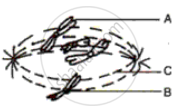
(i) Name the parts of the chromosome labeled A and B.
(ii) Name the structure C. what is its function?
(iii) Name the type of division . Give a reason.
(iv) Name the stage of division.
(v) Name the stages before and after the stage shown in diagram.
In which one of the following options the two stages of mitosis have been given in correct sequence?
The diagram below represents a certain stage of a cell.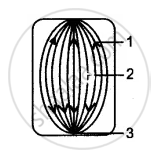
(i) Is it an animal cell or a plant cell ? Give one reason in support of your answer.
(ii) Label the parts numbered 1 – 3.
(iii) Which stage (phase) of mitosis is represented in this diagram
Draw a labeled schematic representation of mitosis cell division.
Draw a well-labelled diagram to show the anaphase stage of mitosis in plant cells having four chromosomes.
Explain the Term Pachytene
Explain the Term Cell Diakinesis
Name the Following
Nuclear envelope and nucleoli reappear in which stage.
Mention, if the following statement is True or False. If false rewrite the wrong statement in its correct form:
The alkaloid colchicine inhibits the formation of the mitotic spindle.
In which stage of mitosis the chromosomes align in an equatorial plate? How?
Give the sequence of the events occurring during the prophase of mitosis.
Identify the stage of mitosis from the below picture. List the chromosomal events in this stage.
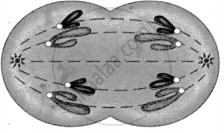
During Mitosis what is the position of chromatids in the anaphase?
