Advertisements
Advertisements
प्रश्न
Explain, why a haemodialysing unit called artificial kidney?
Advertisements
उत्तर
The haemodialysing unit filters nitrogenous wastes from the blood. The dialyzing unit is composed of a cellophane membrane surrounded by a dialyzing fluid. Blood from a convenient artery is channelized to the dialyzing unit. Nitrogenous wastes are filtered through the cellophane membrane because of osmosis. After that filtered blood is channelized back into the body. Since a dialyzing unit substitutes the function of kidney hence it is called an artificial kidney.
APPEARS IN
संबंधित प्रश्न
Write True (T) or False (F) for the following statement. Rewrite the false statement in the correct form.
Removal of solid undigested food is excretion
What are the two ways by which a person can get relief in case of kidney failure?
Draw a diagram of the human excretory system and label the following parts: Kidney, ureter, urinary bladder, and urethra.
What are the symptoms of a urinary tract infection?
Complete the diagram/chart with correct labels/ information. Write the conceptual details regarding it.
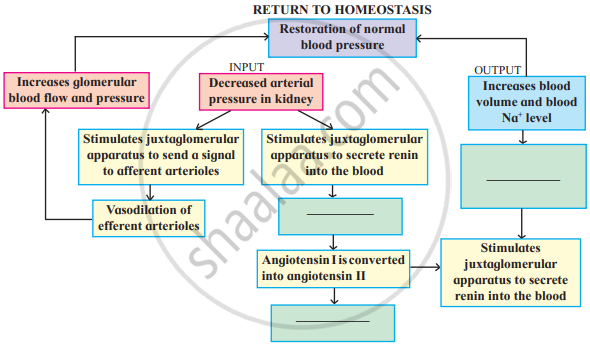
What is the effect of aldosterone on kidneys and where is it produced?
Ketone bodies are found in the urine of people suffering from ______.
Bright's disease is characterized by the following symptoms EXCEPT ______
Dialysis is an imperfect treatment because ______
Haemodialysis is done in the condition when the person is suffering from ______.
Ultimate correction for renal failure is:
What is the procedure advised for the correction of extreme renal failure? Give a brief account of it.
The accumulation of urea in the blood due to malfunctioning of kidneys is referred to as ______.
Renal calculi is ______.
Which statement is correct regarding the haemodialysis procedure?
Oligouria condition in children is when, the urine output is less than ______.
People who consume high protein diet can develop ______ stones.
