Advertisements
Advertisements
प्रश्न
Explain the process of aminoacylation of tRNA and its role in the process of translation.
How and why is charging of tRNA essential in the process of translation?
Advertisements
उत्तर
The process of polymerizing amino acids to create polypeptides is referred to as translation. The nucleotides in the mRNA's sequence determine the order and sequence of amino acids. Peptide bonds, which connect the amino acids, are ultimately hold them together. Energy is needed for peptide bond formation. As a result, during the first phase alone, amino acids are activated in the presence of ATP and connected to their corresponding tRNAs, a process known as charging of tRNA or, to be more precise, aminoacylation of tRNA. It would be energetically advantageous for two of these charged tRNAs to create a peptide bond if they were placed close enough to each other side. A catalyst would speed up the process of peptide bond formation.
संबंधित प्रश्न
Ribosomes are composed of two subunits; the smaller subunit of a ribosome has a binding site for _________ and the larger subunit has two binding sites for two __________.
Regulation of gene expression occurs at the level of ______.
Which cellular process is shown below?
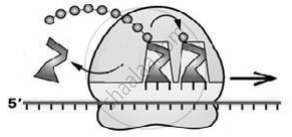
Aminoacylation of tRNA also known as ______.
The process of translation is ______.
Which molecule acts as the template for translation?
Which enzyme is responsible for activating amino acids and attaching them to the correct tRNA?
During the elongation stage of translation, what ensures that the correct amino acid is placed in the sequence?
Which ribosomal site receives the incoming aminoacyl-tRNA during translation?
During elongation, what bonds are formed between adjacent amino acids?
