Advertisements
Advertisements
प्रश्न
Explain the construction and working of an electric generator (AC) with the help of a neat diagram.
Advertisements
उत्तर
A generator which converts mechanical energy into electrical energy in the form of alternating current is called A.C. generator.
Construction: The main components of A.C. generator are:
- Rectangular coil: A large number of turns of insulated copper wire wound on iron core in rectangular shape form a coil ABCD as shown in the figure.
- Strong magnets: The coil is placed in between two pole pieces (N and S) of a strong magnet. This provides a strong magnetic field.
- Rings: The two ends of the coil are connected to two rings R1 and R2. These rings rotate along with the coil.
- Brushes: Two carbon brushes B1 and B2 are used to press the rings.
- Axle: The two rings have resistive coating in their inner surfaces and are tightly fitted on the axle and the function of the axle is to rotate with the coil.
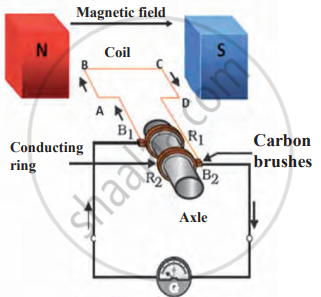
Working:
- When the axle is rotated with the help of a machine from outside, the coil ABCD starts rotating.
- On rotating the axle, the branch AB move upwards and branch CD move downwards hence coil ABCD rotates clockwise.
- According to Fleming’s right-hand rule, electric current flows in the direction A→B→C→D. Therefore, current flows from B2 to B1 in the external circuit through a galvanometer.
- After half rotation, the branch AB and CD exchange their position and the induced current flows as D→B→A.
- Since, branch BA is in contact with brush B1 and branch DC is in contact with B2, current flow from B1 to B2 in the external circuit i.e., in the direction opposite to the previous half rotation.
- This repeats after every half rotation and in this way, an alternate current is produced using an AC generator.
APPEARS IN
संबंधित प्रश्न
Name the device which converts mechanical energy into electric energy.
Name the phenomenon which is made use of in an electric generator.
What type of generator is used at Power Stations?
What is the function of brushes in an electric generator?
What is the major difference between the simple alternator and most practical alternators?
Complete the following sentence:
A generator with commutator produces ............... current.
State two ways in the which the current alternating current and direct current?
Draw the labelled diagram of an A.C. generator. With the help of this diagram, explain the construction and working of an A.C. generator.
A d.c. generator is based on the principle of:
(a) electrochemical induction
(b) electromagnetic induction
(c) magnetic effect of current
(d) heating effect of current
The current induced in a closed circuit only if there is ______.
Suggest two ways in an a.c. generator to produce a higher e.m.f.
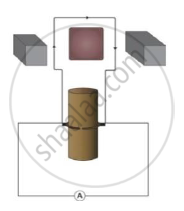
Observe the figure and answer the following questions.
a) Identify the machine shown in figure.
b) Write a use of this machine.
c) How transformation of energy takes place in this machine.
An a.c. generator changes the ______energy to ______ energy.
Observe the figure and write the answers to the questions asked.
- The construction shown in the figure is of which device?
- Explain the principle on which this device works.
- Write any three uses of this device.
Draw and label the diagram of an AC generator.
An AC generator is provided with ______ slip rings that rotate with the coil.
State one factor that affects the magnitude of induced current in an AC generator.
What does the negative sign in Faraday's Law indicate?
What causes a continuously alternating EMF in an a.c. generator?
What is the field magnet made of, and what does it provide?
When is the magnetic flux maximum if the coil starts perpendicular to \[B\]?
How is angular speed related to frequency of rotation \[n\]?
How is peak current related to peak EMF and external resistance?
What voltage range is given as an example for generators in real power stations?
Which energy source and sequence describe generator use in a nuclear power plant?
