Advertisements
Advertisements
प्रश्न
Explain the different steps involved during primary treatment phase of sewage.
Advertisements
उत्तर
The primary treatment phase of sewage involves the removal of coarse solid materials through filtration and sedimentation. The diluted sewage is passed through a series of filters of sequentially small pore sizes to remove large floating objects. Then the filtered sewage is passed into the grit chamber where the coarse solid materials settle by gravity. After this, the sewage is allowed to pass into a sedimentation tank where the suspended materials settle and form the primary sludge. The effluent is then taken for the secondary treatment.
APPEARS IN
संबंधित प्रश्न
What are flocs with respect to sewage treatment?
______ refers to the organic matter which settles down after physical treatment of sewage.
Study the following statements regarding tertiary treatment of sewage and choose the correct option.
i. It produces methane gas.
ii. The effluents formed from these plants undergo chlorination.
iii. BOD is significantly increased at this step.
iv. It includes screening and passage of effluent through grit chamber.
In the process of sewage treatment, the activated sludge is digested by ______
In which of the following step large and small particles are removed from sewage through sequential filtration and sedimentation?
What would happen if oxygen availability to activated sludge flocs is reduced?
Study the given diagram of the Sewage Treatment Plant (S.T.P.) and answer the question that follows:
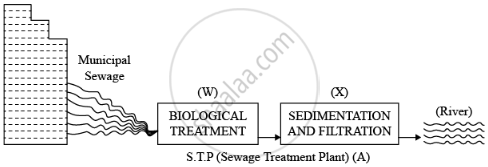
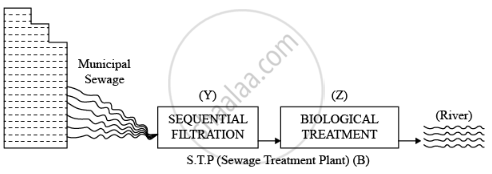
- Which one of the two 'S.T.P.' (A) or (B) will be more effective in treating the human excreta in municipal waste?
- Write the steps followed in carrying the treatment of the sewage in step (Z), once the BOD of sewage is reduced significantly till it is passed on to the "anaerobic sludge digesters".
What is the major component of municipal wastewater (sewage)?
Biochemical Oxygen Demand (BOD) serves as an indirect measure of which water quality parameter?
Which mixture of gases is collectively produced as biogas during anaerobic sludge digestion?
