Advertisements
Advertisements
प्रश्न
During inelastic collision between two bodies, which of the following quantities always remain conserved?
पर्याय
Total kinetic energy.
Total mechanical energy.
Total linear momentum.
Speed of each body.
Advertisements
उत्तर
Total linear momentum.
Explanation:
If in a collision kinetic energy after collision is not equal to kinetic energy before the collision, the collision is said to be inelastic.
Coefficient of restitution 0 < e < 1
When we are considering the two bodies as systems the total external force on the system will be zero.
Hence, the total linear momentum of the system remains conserved.
Here kinetic energy appears in other forms, i.e. energy may be lost in the form of heat and sound etc. In some cases
`(KE)_"final" < (KE)_"initial"` such as when initial KE is converted into internal energy of the product (as heat, elastic or excitation) while in other cases `(KE)_"final" > (KE)_"initial"` such as when internal energy stored in the colliding particles is released.
Examples: (1) The collision between two billiard balls.
(2) The collision between two automobiles on a road.
In fact, the majority of collisions belong to this category.
APPEARS IN
संबंधित प्रश्न
Answer carefully, with reason:
In an inelastic collision of two billiard balls, is the total kinetic energy conserved during the short time of collision of the balls (i.e., when they are in contact)?
Answer carefully, with reason:
If the potential energy of two billiard balls depends only on the separation distance between their centres, is the collision elastic or inelastic? (Note, we are talking here of potential energy corresponding to the force during collision, not gravitational potential energy.)
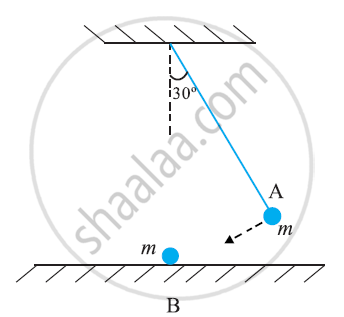
The bob A of a pendulum released from 30° to the vertical hits another bob B of the same mass at rest on a table, as shown in the figure. How high does the bob A rise after the collision? Neglect the size of the bobs and assume the collision to be elastic.
A bullet of mass 0.012 kg and horizontal speed 70 m s–1 strikes a block of wood of mass 0.4 kg and instantly comes to rest with respect to the block. The block is suspended from the ceiling by means of thin wires. Calculate the height to which the block rises. Also, estimate the amount of heat produced in the block.
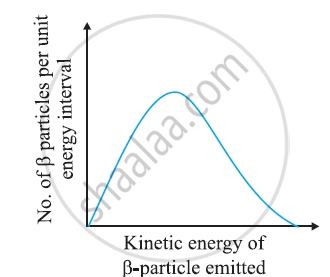
Consider the decay of a free neutron at rest : n → p + e–
Show that the two-body decay of this type must necessarily give an electron of fixed energy and, therefore, cannot account for the observed continuous energy distribution in the β-decay of a neutron or a nucleus
Define coefficient of restitution.
Answer the following question.
Discuss the following as special cases of elastic collisions and obtain their exact or approximate final velocities in terms of their initial velocities.
- Colliding bodies are identical.
- A very heavy object collides on a lighter object, initially at rest.
- A very light object collides on a comparatively much massive object, initially at rest.
Answer the following question.
A bullet of mass m1 travelling with a velocity u strikes a stationary wooden block of mass m2 and gets embedded into it. Determine the expression for loss in the kinetic energy of the system. Is this violating the principle of conservation of energy? If not, how can you account for this loss?
A ball is thrown vertically down from height of 80 m from the ground with an initial velocity 'v'. The ball hits the ground, loses `1/6`th of its total mechanical energy, and rebounds back to the same height. If the acceleration due to gravity is 10 ms-2, the value of 'v' is
A bomb of mass 9 kg explodes into two pieces of mass 3 kg and 6 kg. The velocity of mass 3 kg is 16 m/s, The kinetic energy of mass 6 kg is ____________.
In inelastic collision, ____________.
A block of mass 'm' moving along a straight line with constant velocity `3vec"v"` collides with another block of same mass at rest. They stick together and move with common velocity. The common velocity is ______.
A smooth sphere of mass 'M' moving with velocity 'u' directly collides elastically with another sphere of mass 'm' at rest. After collision, their final velocities are V' and V respectively. The value of V is given by ______.
Two identical ball bearings in contact with each other and resting on a frictionless table are hit head-on by another ball bearing of the same mass moving initially with a speed V as shown in figure.
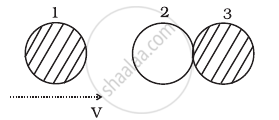
If the collision is elastic, which of the following (Figure) is a possible result after collision?
A ball of mass m, moving with a speed 2v0, collides inelastically (e > 0) with an identical ball at rest. Show that for head-on collision, both the balls move forward.
The bob A of a pendulum released from horizontal to the vertical hits another bob B of the same mass at rest on a table as shown in figure.
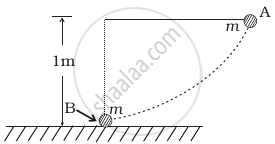
If the length of the pendulum is 1 m, calculate
- the height to which bob A will rise after collision.
- the speed with which bob B starts moving. Neglect the size of the bobs and assume the collision to be elastic.
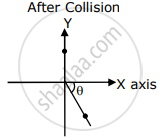
A ball of mass 10 kg moving with a velocity of 10`sqrt3` ms–1 along the X-axis, hits another ball of mass 20 kg which is at rest. After collision, the first ball comes to rest and the second one disintegrates into two equal pieces. One of the pieces starts moving along Y-axis at a speed of 10 m/s. The second piece starts moving at a speed of 20 m/s at an angle θ (degree) with respect to the X-axis.
The configuration of pieces after the collision is shown in the figure.
The value of θ to the nearest integer is ______.
A drunkard walking in a narrow lane takes 5 steps forward and 3 steps backward, followed again by 5 steps forward and 3 steps backward, and so on. Each step is 1 m long and required 1 s to cover. How long the drunkard takes to fall in a pit 13 m away from the start?
