Advertisements
Advertisements
प्रश्न
Draw a ray diagram to show the refraction of a monochromatic ray through a prism when it suffers minimum deviation
Advertisements
उत्तर
Refraction of a monochromatic ray through a prism when it goes through minimum deviation:

APPEARS IN
संबंधित प्रश्न
After tracing the path of a ray of light passing through a rectangular glass slab for four different values of the angle of incidence, a student reported his observations in tabular form as given below:
| S.No | ∠ i | ∠ r | ∠ e |
| I | 30° | 19° | 29° |
| II | 40° | 28° | 40° |
| III | 50° | 36° | 50° |
| IV | 60° | 40° | 59° |
The best observation is
(A) I
(B) II
(C) III
(D) IV
Light passes through a rectangular glass slab and through a triangular glass prism. In what way does the direction of the two emergent beams differ and why?
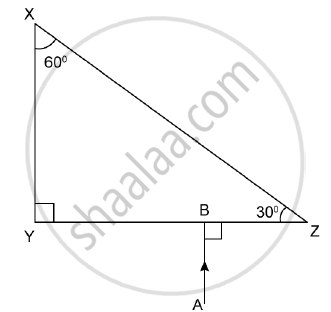
The following diagram shows a 60°, 30°, 90° glass prism of critical angle 42°, Copy the diagram and complete the path of incident ray AB emerging out of the prism marking the angle of incidence on each surface.
How does the speed of light change when it passes from glass to water?
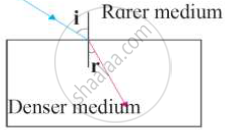
Observe the figure and write accurate conclusion regarding refraction of light.
Draw a ray diagram showing the lateral displacement of a ray of light when it passes through a parallel sided glass slab.
How does the deviation produced by a prism depend on the wavelength of incident light?
Why is the colour red used as a sign of danger?
Consider these indices of refraction: glass: 1.52; air: 1.0003; water: 1.333. Based on the refractive indices of three materials, arrange the speed of light through them in decreasing order.
