मराठी
तामिळनाडू बोर्ड ऑफ सेकेंडरी एज्युकेशनएचएससी विज्ञान इयत्ता १२

Discuss about simple microscope and obtain the equations for magnification for near point focusing and normal focusing. - Physics

Advertisements
Advertisements

प्रश्न

Discuss about simple microscope and obtain the equations for magnification for near point focusing and normal focusing.

दीर्घउत्तर
Advertisements

उत्तर

  1. A simple microscope is a single magnifying (converging) lens of small focal length The idea is to get an erect, magnified and virtual image of the object.
  2. Near point focusing –
    The image is formed at near point, i.e. 25 cm for normal eye. This distance is also called as least distance D of distinct vision. In this position, the eye feels comfortable but there is little strain on the eye.
  3. Normal focusing –
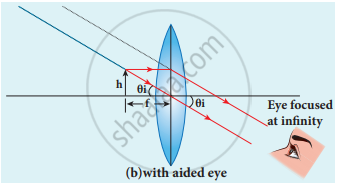
    The image is formed at infinity. In this position the eye is most relaxed to view the image.
    > Object distance u is less than f. The image distance is the near point D. The magnification m is given by the relation,
    m = `"v"/"u"`
  4. With the help of lens equation,
    `1/"v" − 1/"u" = 1/"f"` the magnification can further be written as,
    m = 1 – `"v"/"f"`
  5. Substituting for v with sign convention,
    v = -D
  6. m = `1 + "D"/"f"`
    This is the magnification for near-point focusing.

    Near point focusing
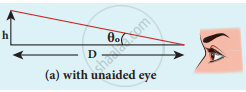
  7. The angular magnification is defined as the ratio of angle θi subtended by the image with an aided eye to the angle θ0 subtended by the object with the unaided eye.
    m = `theta_"i"/theta_0`

    Normal focusing
  8. For unaided eye shown in Figure (a),
    tan θ0 ≈ θ0 = `"h"/"D"`
  9. For aided eye shown in Figure (b),
    tan θi ≈ θi = `"h"/"f"`
  10. The angular magnification is,
    m = `θ_"i"/θ_0` = `("h"//"f")/("h"//"D")`
    m = `"D"/"f"`
    This is the magnification for normal focusing.
shaalaa.com
Optical Instruments
  या प्रश्नात किंवा उत्तरात काही त्रुटी आहे का?
पाठ 7: Wave Optics - Evaluation [पृष्ठ १०४]

APPEARS IN

सामाचीर कलवी Physics - Volume 1 and 2 [English] Class 12 TN Board
पाठ 7 Wave Optics
Evaluation | Q 12. | पृष्ठ १०४

संबंधित प्रश्‍न

Answer the following question in detail.

What is a terrestrial telescope and an astronomical telescope?


Answer the following question in detail.

What is the limitation in increasing the magnifying powers of the astronomical telescope?


Discuss about simple microscope and obtain the equations for magnification for near point focusing and normal focusing.


Why is oil-immersed objective preferred in a microscope?


What is the use of collimator in a spectrmeter?


What are the uses of spectrometer?


What is myopia?


What is hypermetropia?


What is presbyopia?


Discuss about astronomical telescope.


Mention different parts of the spectrometer.


A compound microscope has a magnification of 30. The focal length of eye piece is 5 cm. Assuming the final image to be at least distance of distinct vision, find the magnification produced by the objective.


A compound microscope has a magnifying power of 100 when the image is formed at infinity. The objective has a focal length of 0.5 cm and the tube length is 6.5 cm. What is the focal length of the eyepiece.


There are four convex lenses L1, L2, L3 and L4 of focal length 2, 4, 6 and 8 cm, respectively. Two of these lenses from a telescope of length 10 cm and magnifying power 4. The objective and eye lenses are respectively


If astronomical telescope of length 1.53 m has magnifying power of magnitude 50, the values of fo and fe are ____________.


A simple microscope is used to see the object first in blue light and then in red light. Due to the change from blue to red light, what is the effect on its magnifying power?


An object viewed from a near point distance of 25 cm, using a microscopic lens with magnification '6', gives an unresolved image. A resolved image is observed at infinite distance with a total magnification double the earlier using an eyepiece along with the given lens and a tube of length 0.6 m, if the focal length of the eyepiece is equal to ______ cm.


Share
Notifications

Englishहिंदीमराठी


      Forgot password?
Use app×