Advertisements
Advertisements
प्रश्न
Digital signals
(i) Do not provide a continuous set of values,
(ii) Represent values as discrete steps,
(iii) Can utilize binary system, and
(iv) Can utilize decimal as well as binary systems.
Which of the above statements are true?
(a) (i) and (ii) only
(b) (ii) and (iii) only
(c) (i), (ii) and (iii) but not (iv)
(d) All of (i), (ii), (iii) and (iv).
Advertisements
उत्तर
(c) Answer:
A digital signal uses the binary (0 and 1) system for transferring message signals. Such a system cannot utilise the decimal system (which corresponds to analogue signals). Digital signals represent discontinuous values.
संबंधित प्रश्न
Which of the following frequencies will be suitable for beyond-the-horizon communication using sky waves?
(a) 10 kHz
(b) 10 MHz
(c) 1 GHz
(d) 1000 GHz
Frequencies in the UHF range normally propagate by means of:
(a) Ground waves.
(b) Sky waves.
(c) Surface waves.
(d) Space waves.
Whatis the difference between analogue signal and. digital signal?
Answer the following question :
Define 'bandwidth' and describe briefly its importance in communicating signals ?
Block diagram of a receiver is shown in the figure:
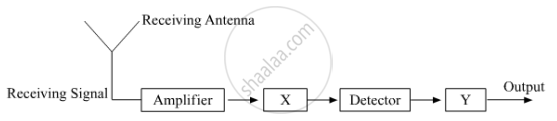
(a) Identify ‘X’ and ‘Y’.
(b) Write their functions.
Write any two factors which justify the need for modulating a signal ?
Draw a diagram showing an amplitude modulated wave by superposing a modulating signal over a sinusoidal carrier wave.
What do you mean by bandwidth of a signal? Give its importance.
A TV tower has a height of 100 meter. If the coverage range is to be made three times then the height of the tower should be increased by.
The area of the region covered by the TV broadcast by a TV tower of 100 m height is (Radius of the earth = 6.4 × 10⁶ m):
Long distance short-wave radio broadcasting uses
Broadcasting antennas are generally
The sound produced by a funning fark is a sort of:-
The audio frequency range is
Broadcast band in which FM lies is ______.
Would sky waves be suitable for transmission of TV signals of 60 MHz frequency?
