Advertisements
Advertisements
प्रश्न
Differentiate between Analog and Digital communication.
Advertisements
उत्तर १
The signal (current or voltage) in the form of continuous, time-varying voltage or current are called continuous or analogue signals. Shows a pulse waveform in which only discrete values of voltages are possible. It is convenient to use binary mumbers to represent such signals.
उत्तर २
An analog communication system uses analog signals for the transfer of information whereas a digital communication system uses digital signals for the transfer of information. In analog communications, signals are consist of continuous values but in digital communications, signals are consist of discrete values.
संबंधित प्रश्न
Which of the following frequencies will be suitable for beyond-the-horizon communication using sky waves?
(a) 10 kHz
(b) 10 MHz
(c) 1 GHz
(d) 1000 GHz
Frequencies in the UHF range normally propagate by means of:
(a) Ground waves.
(b) Sky waves.
(c) Surface waves.
(d) Space waves.
Digital signals
(i) Do not provide a continuous set of values,
(ii) Represent values as discrete steps,
(iii) Can utilize binary system, and
(iv) Can utilize decimal as well as binary systems.
Which of the above statements are true?
(a) (i) and (ii) only
(b) (ii) and (iii) only
(c) (i), (ii) and (iii) but not (iv)
(d) All of (i), (ii), (iii) and (iv).
Block diagram of a receiver is shown in the figure:
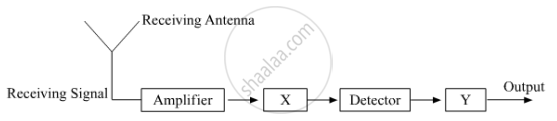
(a) Identify ‘X’ and ‘Y’.
(b) Write their functions.
Distinguish between ‘Analog and Digital signals’.
What do you mean by bandwidth of a signal? Give its importance.
A TV tower has a height of 100 meter. If the coverage range is to be made three times then the height of the tower should be increased by.
Broadcasting antennas are generally
What is meant by deviation in frequency of FM wave?
The audio frequency range is
