Advertisements
Advertisements
प्रश्न
Describe the alimentary canal of man
Advertisements
उत्तर
Alimentary canal (digestive tract/gastro-intestinal tract):
The glands associated with the digestive system are the salivary glands, gastric glands, pancreas, liver and intestinal glands.
- Structure of the Alimentary Canal: Alimentary canal is a muscular coiled, tubular structure. It consists of mouth, buccal cavity, pharynx, oesophagus, stomach, small intestine (consisting of duodenum, jejunum and ileum), large intestine (consisting of caecum, colon and rectum) and anus.
Parts of Human diegestive syetem

1. Mouth: The mouth leads into the buccal cavity. It is bound by two soft, movable upper and lower lips. The buccal cavity is a large space-bound above by the palate (which separates the windpipe and food tube), below by the throat and on the sides by the jaws. The jaws bear teeth.
2. Teeth: Teeth are hard structures meant for holding, cutting, grinding and crushing the food. In human beings, two sets of teeth (Diphyodont) are developed in their lifetime. The first appearing set of 20 teeth called temporary or milk teeth are replaced by the second set of thirty-two permanent teeth, sixteen in each jaw. Each tooth has a root fitted in the gum (Theocodont). Permanent teeth are of four types (Heterodont), according to their structure and function namely incisors, canines, premolars, and molars.
3. Salivary glands: Three pairs of salivary glands are present in the mouth cavity. They are: parotid glands, sublingual glands and submaxillary or submandibular glands
- Parotid glands are the largest salivary glands, which lie in the cheeks in front of the ears (in Greek Par – near; otid – ear).
- Sublingual glands are the smallest glands and lie beneath the tongue.
- Submaxillary or Submandibular glands lie at the angles of the lower jaw. The salivary glands secrete a viscous fluid called saliva, approximately 1.5 liters per day. It digests starch by the action of the enzyme ptyalin (amylase) in the saliva which converts starch (polysaccharide) into maltose (disaccharide). Saliva also contain an antibacterial enzyme called lysozyme.
4. Tongue: The tongue is a muscular, sensory organ which helps in mixing the food with the saliva. The taste buds on the tongue help to recognize the taste of food.
The masticated food in the buccal cavity becomes a bolus which is rolled by the tongue and passed through pharynx into the oesophagus by swallowing. During swallowing, the epiglottis (a muscular flap-like structure at the tip of the glottis, beginning of trachea) closes and prevents the food from entering into trachea (wind pipe).
5. Pharynx is a membrane lined cavity behind the nose and mouth, connecting them to the oesophagus. It serves as a pathway for the movement of food from mouth to oesophagus.
6. Oesophagus or the food pipe is a muscular-membranous canal about 22 cm in length. It conducts food from pharynx to the stomach by peristalsis (wave-like movement) produced by the rhythmic contraction and relaxation of the muscular walls of alimentary canal.
7. Stomach is a wide J-shaped muscular organ located between oesophagus and the small intestine. The gastric glands present in the inner walls of the stomach secrete gastric juice. The gastric juice is colourless, highly acidic, containing mucus, hydrochloric acid and enzymes rennin (in infants) and pepsin.
8. Small intestine is the longest part of the alimentary canal, which is a long coiled tube measuring about 5 – 7 m. It comprises three parts- duodenum, jejunum and ileum.
- Duodenum is C-shaped and receives the bile duct (from liver) and pancreatic duct (from the pancreas).
- Jejunum is the middle part of the small intestine. It is a short region of the small intestine. The secretion of the small intestine is intestinal juice which contains enzymes like sucrase, maltase, lactase and lipase.
- Ileum forms the lower part of the small intestine and opens into the large intestine. Ileum is the longest part of the small intestine. It contains minute finger-like projections called villi (one millimeter in length) where absorption of food takes place. They are approximately 4 million in number. Internally, each villus contains fine blood capillaries and lacteal tubes.
The small intestine serves both for digestion and absorption. It receives
- the bile from liver and
- the pancreatic juice from pancreas in the duodenum. The intestinal glands secrete the intestinal juices.
9. Liver is the largest digestive gland of the body which is reddish brown in colour. It is divided into two main lobes, right and left lobes. The right lobe is larger than the left lobe. On the under surface of the liver, gall bladder is present. The liver cells secrete bile which is temporarily stored in the gall bladder.
10. Pancreas is a lobed, leaf shaped gland situated between the stomach and duodenum. Pancreas acts both as an exocrine gland and as an endocrine gland. The gland’s upper surface bears the islets of Langerhans which have endocrine cells and secrete hormones in which α (alpha) cells secrete glucagon and β (beta) cells secrete insulin.
The intestinal glands secrete intestinal juice called succusentericus which contains enzymes like maltase, lactase, sucrase and lipase which act in an alkaline medium. From the duodenum the food is slowly moved down to ileum, where the digested food gets absorbed
11. Large intestine
The unabsorbed and undigested food is passed into the large intestine. It extends from the ileum to the anus. It is about 1.5 meters in length. It has three parts- caecum, colon and rectum.
The caecum is a small blind pouch like structure situated at the junction of the small and large intestine. From its blind end a finger – like structure called vermiform appendix arises. It is a vestigeal (functionless) organ in human beings.
The colon is much broader than ileum. It passes up the abdomen on the right (ascending colon), crosses to the left just below the stomach (transverse colon) and down on the left side (descending colon).
The rectumis the last part which opens into the anus. It is kept closed by a ring of muscles called anal sphincter which opens when passing stools.
APPEARS IN
संबंधित प्रश्न
Name any four life processes in living things.
Where is digested food absorbed into blood in human body?
What is the function of enzymes in the human digestive system?
The process of digestion in humans is completed in ______.
| When a person eats sugary food, then organisms A present in his mouth act on sugar to produce a substance B. The substance B first dissolves the calcium salts from the top part C of the tooth and then from its middle part D forming holes E. These holes ultimately reach the part F in the lower part of tooth which contains nerves and blood vessels. The substance B irritates the nerve endings inside the tooth causing toothache. |
- What are (i) organisms A, and (ii) substance B?
- What are (i) part C, and (ii) part D, of tooth known as?
- By what name are the holes E in the tooth known?
- Name the part F of the tooth.
- What will happen if organisms A reach part F of the tooth known?
List the enzymes and their action on food in the stomach and intestine.
Given alongside is the diagram of the human alimentary canal.
(i) Name the parts 1-11 indicated by guidelines.
1.____ 2.____ 3.____ 4.____ 5.____ 6.____ 7.____ 8.____ 9.____ 10.___ 11.____
(ii) State the function of the juice secreted by the part 1.
(iii) State the function of the three enzymes found in the juice secreted by part 3.

Define homodont dentition.
The question has four options. Choose the correct answer:
Stomach in vertebrates is the chief site of digestion of
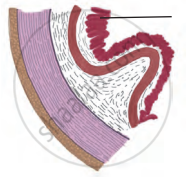
Observe the diagram. This is the histological structure of the stomach. Identify and comment on the significance of the layer marked by an arrow.
The process by which the body removes waste is called ______.
______ is the common passage of air and food.
Identify the correct human dental formula.
A fluid containing the digestive enzyme ____________ is secreted by the serous cells of salivary gland.
Select the correct pair of peptide hormones secreted by the alimentary canal.
Cud is the name given to the food of ruminants which is ______.
Cellulose-rich food substances are good source of roughage in human beings because ______.
Mark the following statement as True or False. If false, write the correct statement.
All heterotrophs have a similar basic process of nutrition.
Curdling of milk protein is done by ______.
What are the end products of digestion of starch, proteins, and fats respectively?
