Advertisements
Advertisements
प्रश्न
Explain the structure of kidney and the steps involved in the formation of urine
Advertisements
उत्तर
Longitudinal section of human kidney

Kidneys are bean-shaped organs reddish brown in colour. The kidneys lie on either side of the vertebral column in the abdominal cavity attached to the dorsal body wall. The right kidney is placed lower than the left kidney as the liver takes up much space on the right side. Each kidney is about 11 cm long, 5 cm wide and 3 cm thick. The kidney is covered by a layer of fibrous connective tissue, the renal capsules, adipose capsule and a fibrous membrane.
Internally the kidney consists of an outer dark region, the cortex and an inner lighter region, the medulla. Both of these regions contain uriniferous tubules or nephrons. The medulla consists of multitubular conical masses called the medullary pyramids or renal pyramids whose bases are adjacent to cortex. On the inner concave side of each kidney, a notch called hilum is present through which blood vessels and nerves enter in and the urine leaves out.
Ureters are thin muscular tubes emerging out from the hilum. Urine enters the ureter from the renal pelvis and is conducted along the ureter by peristaltic movements of its walls. The ureters carry urine from kidney to urinary bladder.
Urinary bladder is a sac-like structure, which lies in the pelvic cavity of the abdomen. It stores urine temporarily.
Urethra is a membranous tube, which conducts urine to the exterior. The urethral sphincters keep the urethra closed and opens only at the time of micturition (urination).
- Functions of kidney:
- Maintain the fluid and electrolyte balance in our body.
- Regulate acid-base balance of blood.
- Maintain the osmotic pressure in blood and tissues.
- Help to retain important plasma constituents like glucose and amino acids.
- Structure of Nephron
Each kidney consists of more than one million nephrons. Nephrons or uriniferous tubules are structural and functional units of the kidneys.
Each nephron consists of Renal corpuscle or Malphigian corpuscle and renal tubule. The renal corpuscle consists of a cup-shaped structure called Bowman’s capsule containing a bunch of capillaries called glomerulus. Blood enters the glomerular capillaries through afferent arterioles and leaves out through efferent arterioles.
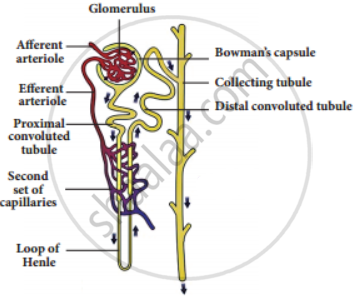
The Bowman’s capsule continues as the renal tubule which consists of three regions proximal convoluted tubule, U-shaped hair pin loop, the loop of Henle and the distal convoluted tubule. The distal convoluted tubule which opens into the collecting tubule. The nitrogenous wastes are drained into renal pelvis which leads to ureters and stored in the urinary bladder. Urine is expelled out through the urethra.
- Mechanism of Urine Formation
The process of urine formation includes the following three stages.
- Glomerular filtration
- Tubular reabsorption and
- Tubular secretion
1. Glomerular filtration: Urine formation begins with the filtration of blood through epithelial walls of the glomerulus and Bowman’s capsule, The filtrate is called as the glomerular filtrate. Both essential and non-essential substances present in the blood are filtered.
2. Tubular reabsorption: The filtrate in the proximal tubule consists of essential substances such as glucose, amino acids, vitamins, sodium, potassium, bicarbonates, and water that are reabsorbed into the blood by a process of selective reabsorption.
3. Tubular secretion: Substances such as H+ or K+ ions are secreted into the tubule. Certain substances like potassium and a large number of drugs like penicillin and aspirin are passed into the filtrate in the distal convoluted tubule. This tubular filtrate is finally known as urine, which is hypertonic in man. Finally, the urine passes into collecting ducts to the pelvis and through the ureter into the urinary bladder by urethral peristalsis (waves of constriction in the ureters.
The relaxation of sphincter muscles located at the opening of the urinary bladder into the urethra. When the urinary bladder is full the urine is expelled out through the urethra. This process is called micturition. A healthy person excretes one to two litres of urine per day.
APPEARS IN
संबंधित प्रश्न
Explain the structure of nephron.
Glucose is reabsorbed from the glomerular filtrate mainly in the ____________.
The loop of Henle and collecting ducts lie in the ____________ of the kidney.
The tubular filtrate is finally known as ______.
Name the following:
Knot-like mass of blood capillary inside Bowman's capsule.
The statement given below is false. Rewrite the correct form of the statement by changing the underlined word.
A pair of renal arteries branch off from the vena cava and enter the kidney.
The statement given below is false. Rewrite the correct form of the statement by changing the underlined word.
The glomerular filtrate is collected in Bowman's capsule after the process of reabsorption.
Write down the functional activity of the following parts:
Collecting duct
Write down the functional activity of the following parts:
Vasa recta
Assertion A: Nephrons are of two types: Cortical & Juxta medullary, based on their relative position in cortex and medulla.
Reason R: Juxta medullary nephrons have short loop of Henle whereas, cortical nephrons have longer loop of Henle.
In the light of the above statements, choose the correct answer from the options given below:
