Advertisements
Advertisements
प्रश्न
Describe simple experiments to show the presence of -
oxygen and nitrogen component in air using a bell jar
Advertisements
उत्तर
Oxygen and nitrogen in air:
Apparatus— A through, a bell jar, a cork and a crucible and a piece of white phosphorus.
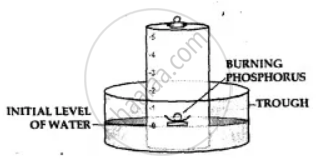
producer-
- The trough is filled with water and a bell jar divided into 5 equal parts, ‘1 to 5’ is placed over it.
- A crucible containing white phosphorus is placed on a cork which is made to float on water.
- The level of the water inside and outside are adjusted to one level.
- The phosphorus is then ignited by means of a heated wire.
Observation-
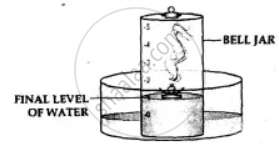
- The phosphorus burns in the active component of air [oxygen] forming – dense white fumes of phosphorus pentoxide [P2O5]. Phosphorus + Oxygen →Phosphorus pentoxide
- The level of the water in the bell jar rises by l/5th.
Conclusion-
- Oxygen— The active component of air, i.e. 1/5th of air, is used up in burning.
- Nitrogen— The inactive component of air, i.e. 4/ 5 of air, is not used up in burning. Hence air contains oxygen which supports combustion and nitrogen which does not.
APPEARS IN
संबंधित प्रश्न
Define the term acid rain.
What is rust ?
State two differences between:
Rusting and burning.
What happens when potassium nitrate is heated ?
What happens when Iron burns in oxygen ? Also give the balanced chemical equation for the reaction.
What is rusting?
State four ways of preventing rusting.
In the laboratory preparation of oxygen from hydrogen peroxide answer the following:
Name the catalyst used in the preparation and state it’s function.
Give the main experimental points only to demonstrate that magnesium.
What is meant by burning?
