Advertisements
Advertisements
प्रश्न
Give the main experimental points only to demonstrate that candle-gains weight on burning.
थोडक्यात उत्तर
Advertisements
उत्तर
Candle gains weight on burning
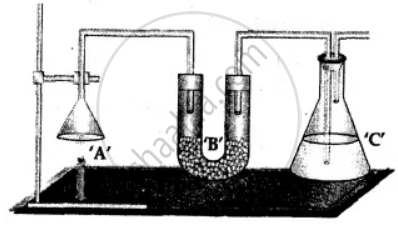
1. Weight: The complete apparatus as shown above which includes -
- Unlit candle ‘A’.
- U tube ‘B’ containing anhydrous CaCl2.
- Conical flask ‘C’ containing cone. KOH soln.
Total wt. = a gms.
The candle ‘A’ is then lit and the products obtained on burning are allowed to be absorbed in U tube ‘B’ and conical flask ‘C’.
2. Re-weigh: The complete apparatus as shown above after the candle has burnt – for a known period of time.
Total wt. = b gms.
Result:
- ‘b’ gms. is greater than ‘a’ gms.
- weight of apparatus after absorbtion
- of products is greater than the original weight of the apparatus.
Conclusion: Candle gains weight due to mass of oxygen of the air which has combined with ‘carbon’ and ‘hydrogen’ of the candle [CxHy] producing .
- Water vapour [absorbed by anhydrous CaCl2]
- Carbon dioxide [absorbed by cone. KOH soln].
shaalaa.com
Burning and Combustion
या प्रश्नात किंवा उत्तरात काही त्रुटी आहे का?
