Advertisements
Advertisements
प्रश्न
Construct an equilateral Δ ABC such that:
AB = 5 cm. Draw the perpendicular bisectors of BC and AC. Let P be the point of intersection of these two bisectors. Measure PA, PB, and PC.
Advertisements
उत्तर
Steps of Construction :
(i) Draw a line segment AB = 5 cm.
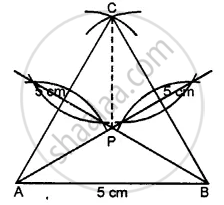
(ii) With centres A and B and radius 5 cm each, draw two arcs intersecting each other at C.
(iii) Join AC and BC ∆ ABC is the required triangle.
(iv) Draw the perpendicular bisectors of sides AC and BC which intersect each other at P.
(v) Join PA, PB, and PC.
On measuring, each is 2.8 cm.
APPEARS IN
संबंधित प्रश्न
Construct a ∆ABC such that:
BC = 4 cm, AC = 5 cm and AB = 3.5 cm
Construct a ∆ ABC such that:
AB = 7 cm, BC = 5 cm and ∠ABC = 60°
Construct a ∆ ABC such that:
BC = 6 cm, AC = 5.7 cm and ∠ACB = 75°
Construct a ∆ ABC such that:
AB = 6.5 cm, AC = 5.8 cm and ∠A = 45°
Construct a ∆ PQR such that :
PQ = 6 cm, ∠Q = 60° and ∠P = 45°. Measure ∠R.
Construct an isosceles Δ ABC such that:
Base AB = 6.2 cm and base angle = 45°. Measure the other two sides of the triangle.
Construct an isosceles Δ ABC such that:
Base AC = 5 cm and base angle = 75°. Measure the other two sides of the triangle.
Construct a ∆ ABC such that AB = 6 cm, BC = 4.5 cm and AC = 5.5 cm. Construct a circumcircle of this triangle.
Construct an isosceles ∆ PQR such that PQ = PR = 6.5 cm and ∠PQR = 75°. Using a ruler and compasses only constructs a circumcircle to this triangle.
Construct a ∆ ABC such that AB = 6 cm, BC = 5.6 cm and CA = 6.5 cm. Inscribe a circle to this triangle and measure its radius.
