Advertisements
Advertisements
प्रश्न
Construct a ∆ABC such that:
BC = 4 cm, AC = 5 cm and AB = 3.5 cm
Advertisements
उत्तर
Steps of Construction :
(i) Draw a line segment BC = 4 cm.
(ii) With centre B and radius 3.5 cm, draw an arc.
(iii) With centre C and radius 5 cm, draw another arc which intersects the first arc at A.
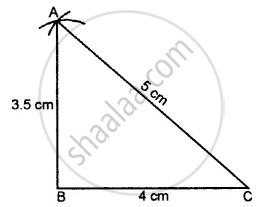
(iv) Join AB and AC.
∆ ABC is the required triangle.
APPEARS IN
संबंधित प्रश्न
Construct a ∆ABC such that:
CB = 6.5 cm, CA = 4.2 cm and BA = 51 cm
Construct a ∆ ABC such that:
AB = 7 cm, BC = 5 cm and ∠ABC = 60°
Construct a ∆ ABC such that:
BC = 6 cm, AC = 5.7 cm and ∠ACB = 75°
Construct a ∆ PQR such that :
PQ = 6 cm, ∠Q = 60° and ∠P = 45°. Measure ∠R.
Construct a ∆ PQR such that:
QR = 4.4 cm, ∠R = 30° and ∠Q = 75°. Measure PQ and PR.
Construct an isosceles Δ ABC such that:
Base BC = 4 cm and base angle = 30°. Measure the other two sides of the triangle.
Construct an isosceles Δ ABC such that:
Base AC = 5 cm and base angle = 75°. Measure the other two sides of the triangle.
Construct an isosceles ∆ ABC such that:
One of the equal sides = 6 cm and vertex angle = 45°. Measure the base angles.
Construct an equilateral Δ ABC such that:
AB = 5 cm. Draw the perpendicular bisectors of BC and AC. Let P be the point of intersection of these two bisectors. Measure PA, PB, and PC.
Construct an isosceles ∆ PQR such that PQ = PR = 6.5 cm and ∠PQR = 75°. Using a ruler and compasses only constructs a circumcircle to this triangle.
