Advertisements
Advertisements
प्रश्न
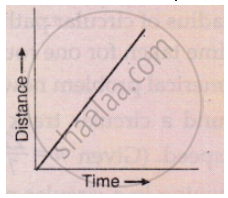
Complete the data of the table given below with the help of the distance-time graph given in the figure.
| Distance (m) | 0 | 4 | ? | 12 | ? | 20 |
| Time (s) | 0 | 2 | 4 | ? | 8 | 10 |

Advertisements
उत्तर
| Distance (m) | 0 | 4 | 8 | 12 | 16 | 20 |
| Time (s) | 0 | 2 | 4 | 6 | 8 | 10 |
APPEARS IN
संबंधित प्रश्न
What can you say about the motion of an object whose distance-time graph is a straight line parallel to the time axis?
What conclusion can you draw about the speed of a body from the following distance-time graph ?
Fill in the following blank with suitable word :
The slope of a distance-time graph indicates ………………….. of a moving body.
Fill in the following blank with suitable word :
The slope of a speed-time graph of a moving body gives its………………………..
Name the two quantities, the slope of whose graph give speed .
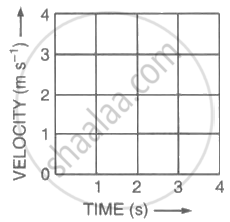
Figure (a) shows the displacement-time graph for the motion of a body. Use it to calculate the velocity of the body at t = 1 s, 2 s and 3 s, and then draw the velocity-time graph in Figure (b) for it.
 |
 |
| (a) | (b) |
A body moves along a straight road with a speed of 20 m/s and has a uniform acceleration of 5 m/s2. What will be its speed after 2 s?
The slope of the distance-time curve is steeper/greater is the ______.
The slope of the distance-time graph indicates the speed.
Assertion: The position-time graph of a uniform motion in one dimension of a body can have a negative slope
Reason: When the speed of the body decreases with time then, the position-time graph of the moving body has a negative slope.
