Advertisements
Advertisements
प्रश्न
Choose the correct option:
The graph shows variation of displacement of a particle performing S.H.M. with time t. Which of the following statements is correct from the graph?
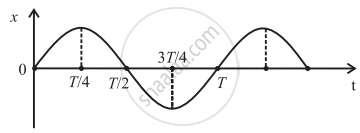
पर्याय
The acceleration is maximum at time T.
The force is maximum at time `(3T)/4`.
The velocity is zero at time `T/2`.
The kinetic energy is equal to total energy at a time `T/4`.
Advertisements
उत्तर
The force is maximum at a time `(3T)/4`.
Explanation:
Express the relation of force. F = ma
Here, m is the mass of the particle.
a is the acceleration.
Since acceleration is maximum at extreme positions, Force is also maximum at extreme positions. At time `(3T)/4` particle is at extreme position. Therefore, at `(3T)/4` force is maximum.
APPEARS IN
संबंधित प्रश्न
Find the change in length of a second’s pendulum, if the acceleration due to gravity at the place changes from 9.75 m/s2 to 9.8 m/s2.
A particle is performing simple harmonic motion with amplitude A and angular velocity ω. The ratio of maximum velocity to maximum acceleration is ______.
Using the differential equation of linear S.H.M., obtain an expression for acceleration, velocity, and displacement of simple harmonic motion.
The light of wavelength '`lambda`'. incident on the surface of metal having work function `phi` emits the electrons. The maximum velocity of electrons emitted is ______.
[c = velocity of light, h = Planck's constant, m = mass of electron]
For a particle performing SHM when displacement is x, the potential energy and restoring force acting on it is denoted by E and F, respectively. The relation between x, E and F is ____________.
The displacement of a particle from its mean position (in metre) is given by, y = 0.2 sin(10 πt + 1.5π) cos(10 πt + 1.5π).
The motion of particle is ____________.
In U.C.M., when time interval δt → 0, the angle between change in velocity (δv) and linear velocity (v) will be ______.
A wheel of M.I. 50 kg m2 starts rotating on applying a constant torque of 200 Nm. Its angular velocity after 2.5 second from the start is ______.
A particle is moving along a circular path of radius 6 m with a uniform speed of 8 m/s. The average acceleration when the particle completes one-half of the revolution is ______.
A body performing a simple harmonic motion has potential energy 'P1' at displacement 'x1' Its potential energy is 'P2' at displacement 'x2'. The potential energy 'P' at displacement (x1 + x2) is ________.
Which of the following represents the acceleration versus displacement graph of SHM?
A body of mass 5 g is in S.H.M. about a point with amplitude 10 cm. Its maximum velocity is 100 cm/s. Its velocity will be 50 cm/s at a distance of, ____________.
The displacement of a particle is 'y' = 2 sin `[(pit)/2 + phi]`, where 'y' is cm and 't' in second. What is the maximum acceleration of the particle executing simple harmonic motion?
(Φ = phase difference)
A body is executing S.H.M. Its potential energy is E1 and E2 at displacements x and y respectively. The potential energy at displacement (x + y) is ______.
A simple pendulum of length 'L' is suspended from a roof of a trolley. A trolley moves in horizontal direction with an acceleration 'a'. What would be the period of oscillation of a simple pendulum?
(g is acceleration due to gravity)
A block of mass 16 kg moving with velocity 4 m/s on a frictionless surface compresses an ideal spring and comes to rest. If force constant of the spring is 100 N/m then how much will be the spring compressed?
The displacement of the particle performing S.H.M. is given by x = 4 sin πt, where x is in cm and t is in second. The time taken by the particle in second to move from the equilibrium position to the position of half the maximum displacement, is ______.
`[sin30^circ=cos60^circ=0.5, cos30^circ=sin60^circ=sqrt3/2]`
The displacement of a particle in S.H.M. is x = A cos `(omegat+pi/6).` Its speed will be maximum at time ______.
A body perform linear simple harmonic motion of amplitude 'A'. At what displacement from the mean position, the potential energy of the body is one fourth of its total energy?
The displacement of a particle is represented by the equation `y = 3 cos (pi/4 - 2ωt)`. The motion of the particle is ______.
A spring of force constant of 400 N/m is loaded with a mass of 0.25 kg. The amplitude of oscillations is 4 cm. When mass comes to the equilibrium position. Its velocity is ______.
The displacement of a particle of mass 3 g executing simple harmonic motion is given by Y = 3 sin (0.2 t) in SI units. The kinetic energy of the particle at a point which is at a distance equal to `1/3` of its amplitude from its mean position is ______.
For a particle performing circular motion, when is its angular acceleration directed opposite to its angular velocity?
State the expression for the total energy of SHM in terms of acceleration.
Which one of the following is not a characteristics of SHM?
