Advertisements
Advertisements
प्रश्न
Answer these question in one or two sentences . (The paragraph numbers within brackets provide clues to the answer.)
Why did Santosh’s parents agree to pay for her schooling in Delhi? What mental qualities of Santosh are brought into light by this incident?
Advertisements
उत्तर
When Santosh informed her parents about her plan to do a part time job to support her education, they agreed to pay for her schooling in Delhi.
This incident shows that Santosh was a strong headed and determined girl who knew her way towards her goal. .
संबंधित प्रश्न
Think about the Text
Discuss in pairs and answer the question below in a short paragraph (30 − 40 words).
“The sound was familiar one.” What sound did the doctor hear? What did he think it
was? How many times did he hear it? (Find the places in the text.) When and why did the
sounds stop?
Thinking about the Text
Discuss in pairs and answer question below in a short paragraph (30 − 40 words).
How many characters are there in the narrative? Name them. (Don’t forget the dog!).
Use suitable words or phrases from Column A above to complete the paragraph given below.
A Traffic Jam
During power cuts, when traffic lights go off, there is utter ____ at crossroads. Drivers add
to the confusion by ____ over their right of way, and nearly come to blows. Sometimes
passers-by, seeing a few policemen ____ at regulating traffic, step in to help. This gives
them a feeling of having ____ something.
Answer of these question in a short paragraph (about 30 words).
How does the author describe: (i) his father, (ii) his mother, (iii) himself?
Read the song once again.
I am dotted silver threads dropped from heaven
By the gods. Nature then takes me, to adorn
Her fields and valleys.
I am beautiful pearls, plucked from the
Crown of Ishtar by the daughter of Dawn
To embellish the gardens.
When I cry the hills laugh;
When I humble myself the flowers rejoice;
When I bow, all things are elated.
The field and the cloud are lovers
And between them I am a messenger of mercy.
I quench the thirst of the one;
I cure the ailment of the other.
The voice of thunder declares my arrival;
The rainbow announces my departure.
I am like earthly life which begins at
The feet of the mad elements and ends
Under the upraised wings of death.
I emerge from the heart of the sea and
Soar with the breeze. When I see a field in
Need, I descend and embrace the flowers and
The trees in a million little ways.
I touch gently at the windows with my
Soft fingers, and my announcement is a
Welcome song. All can hear, but only
The sensitive can understand.
I am the sigh of the sea;
The laughter of the field;
The tears of heaven.
So with love -
Sighs from the deep sea of affection; Laughter from the colourful
field of the spirit; Tears from the endless heaven of memories.
About the Poet
Kahlil Gibran (1883-1931) was a Lebanese-American artist, poet and writer. His
poetry is notable for its use of formal language as well as insights on topics of life using
spiritual terms. One of his most notable lines of poetry in the English-speaking world is
from Sand and Foam (1926) which reads 'Half of what I say is meaningless, but I say
it so that the other half may reach you.'
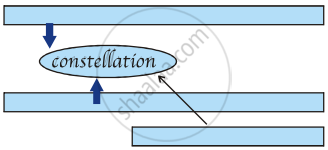
Read the following extracts from the story, and try to puzzle out the meanings of the encircled words from other words and phrases in the extract. Write the clues in the empty boxes. Then give your own explanation of the encircled words.
I saw individual stars, but I could not distinguish the constellation they belonged to. Then dawn came and put out all my stars.
Therefore, constellation means ______.
What does he plant who plants a tree?
He plants cool shade and tender rain,
And seed and bud of days to be,
And years that fade and flush again;
He plants the glory of the plain;
He plants the forest's heritage;
The harvest of a coming age;
The joy that unborn eyes shall see___
These things he plants who plants a tree.
Read the lines given above and answer the question that follow:
Explain with reference to context.
The boy looked up. He took his hands from his face and looked up at his teacher. The light from Mr. Oliver’s torch fell on the boy’s face, if you could call it a face. He had no eyes, ears, nose or mouth. It was just a round smooth head with a school cap on top of it.
And that’s where the story should end, as indeed it has for several people who have had similar experiences and dropped dead of inexplicable heart attacks. But for Mr. Oliver, it did not end there. The torch fell from his trembling hand. He turned and scrambled down the path, running blindly through the trees and calling for help. He was still running towards the school buildings when he saw a lantern swinging in the middle of the path. Mr. Oliver had never before been so pleased to see the night watchman. He stumbled up to the watchman, gasping for breath and speaking incoherently.
What is it, Sahib? Asked the watchman, has there been an accident? Why are you running?
I saw something, something horrible, a boy weeping in the forest and he had no face.
No face, Sahib?
No eyes, no nose, mouth, nothing.
Do you mean it was like this, Sahib? asked the watchman, and raised the lamp to his own face. The watchman had no eyes, no ears, no features at all, not even an eyebrow. The wind blew the lamp out and Mr. Oliver had his heart attack.
Read the extract given below and answer the question that follow.
What did the watchman ask Mr Oliver? ‘
Margot stood alone. She was a very frail girl who looked as if she had been lost in the rain for years and the rain had washed out the blue from her eyes and the red from her mouth and the yellow from her hair. She was an old photograph dusted from an album, whitened away, and if she spoke at all her voice would be a ghost. Now she stood, separate, staring at the rain and the loud wet world beyond the huge glass. “What’re you looking at ?” said William. Margot said nothing. “Speak when you’re spoken to.” He gave her a shove. But she did not move; rather she let herself be moved only by him and nothing else. They edged away from her, they would not look at her. She felt them go away. And this was because she would play no games with them in the echoing tunnels of the underground city. If they tagged her and ran, she stood blinking after them and did not follow. When the class sang songs about happiness and life and games her lips barely moved. Only when they sang about the sun and the summer did her lips move as she watched the drenched windows.
Read the extract given below and answer the question that follow.
What did Margot look like?
They stood in the doorway of the underground for a moment until it was raining hard. Then they closed the door and heard the gigantic sound of the rain falling in tons and avalanches, everywhere and forever.
“Will it be seven more years?” “Yes. Seven.” Then one of them gave a little cry. “Margot!” “What?” “She’s still in the closet where we locked her.” “Margot.”
They stood as if someone had driven them, like so many stakes, into the floor. They looked at each other and then looked away. They glanced out at the world that was raining now and raining and raining steadily. They could not meet each other’s glances. Their faces were solemn and pale. They looked at their hands and feet, their faces down. “Margot.” One of the girls said, “Well.. .?” No one moved. “Go on,” whispered the girl. They walked slowly down the hall in the sound of the cold rain. They turned through the doorway to the room in the sound of the storm and thunder, lightning on their faces, blue and terrible. They walked over to the closet door slowly and stood by it. Behind the closed door was only silence. They unlocked the door, even more slowly, and let Margot out.
Read the extract given below and answer the question that follow.
When would the Sun shine again? Why had the children locked Margot in the closet?
What are the 'present wants'? Who is its need of I~ 'present wants'? Why?
“A sharp V-shaped line had formed between her eyebrows.” What does it suggest to you about Rukku Manni’s mood?
Answer the following question
How did Gopal get inside the palace to see the king after he had bought the fish?
Why was the name plate missing at Mr Gessler’s shop?
Why did Soapy hope to get food at a large and brightly lighted restaurant?
Why did the lady chain the bear on Sundays?
Define a dream in your own words.
Who really helped Vijay Singh in defeating the ghost? How?
Why did the Dog say goodbye to the Wolf?
Fill in the blank to name a different kind of intelligence. One has been done for you.
When I enjoy listening to people and solving their problems I use my interpersonal intelligence
When I enjoy dancing or physical activity, I use my ____________ intelligence.
