Advertisements
Advertisements
प्रश्न
Answer the following question.
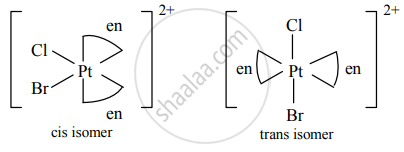
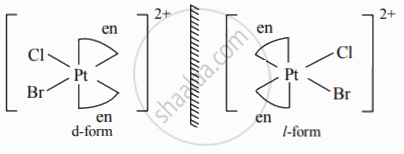
Draw geometric isomers and enantiomers of the following complex.
[Pt(en)2ClBr]2⊕
Advertisements
उत्तर
Geometric isomers of [Pt(en)2ClBr]2⊕:
Enantiomers of [Pt(en)2ClBr]2⊕:
संबंधित प्रश्न
Answer the following in one or two sentences.
Consider the complexes \[\ce{[Cu(NH3)4][PtCl4] and [Pt(NH3)4] [CuCl4]}\]. What type of isomerism these two complexes exhibit?
Draw isomers of the following.
\[\ce{Pt(NH3)2ClNO2}\]
Answer the following question.
Draw isomers of the following
Ru(NH3)4Cl2
Draw structure of cis isomer of [Co(NH3)4Cl2]+
Draw the geometrical isomers of the following complexes [Pt(NH3)(H2O)Cl2].
Which one of the following will give a pair of enantiomorphs?
Which type of isomerism is exhibited by [Pt(NH3)2Cl2]?
Which one of the following complexes is not expected to exhibit isomerism?
Fac-mer isomerism is shown by
Draw all possible geometrical isomers of the complex \[\ce{[Co(en)2Cl2]^+}\] and identify the optically active isomer.
The term anomers of glucose refer to ____________.
Consider the two complexes given below:
\[\ce{\underset{(I)}{[Co(NH3)5SO4]Br}}\] and \[\ce{\underset{(II)}{[Co(NH3)5Br]SO4}}\]
I and II are ____________ isomers.
Which of the following does NOT show optical isomerism?
____________ isomers are formed when the ligand has two different donor atoms.
What type of isomerism is present between (I) [Cr(H2O)6]Cl3 and (II) [Cr(H2O)5Cl]Cl2.H2O?
Geometrical isomerism is not shown by
Complex [COCl2(en)2]+ can
Which of the following shows maximum number of isomers?
Draw geometric isomers of the following complex.
Geometrical isomers of Pt(NH3)2Cl2
Which of the following are isostructural pairs?
(A) \[\ce{SO^{2-}4}\] and \[\ce{CrO^{2-}4}\]
(B) SiCl4 and TiCl4
(C) NH3 and \[\ce{NO^-3}\]
(D) BCl3 and BrCl3
Which of the following compound is optically active?
Give trans isomer of [Co(NH3)4Cl2]⊕.
Write structures for geometrical isomers of diamminebromochloroplatinum (II).
Draw the geometrical isomers of the following complexes [Co(NH3)4Cl2]+
Draw the structure of trans isomers of Pt(NH3)2Cl2.
Which one of the following complex ions has geometrical isomers?
