Advertisements
Advertisements
प्रश्न
Answer the question:
What is meant by the orbit of a satellite? On what basis and how are the orbits of artificial satellites classified?
Advertisements
उत्तर
An orbit is a specific path (elliptical or circular) or trajectory around a planet in which a satellite revolves. Depending on the height of the satellite’s orbit above the Earth’s surface, the satellite orbits are classified as below:
- High Earth Orbits (Height from the earth’s surface > 35780 km): If the height of the satellite’s orbit above the earth’s surface is greater than or equal to 35780 km, the orbit is called High earth Orbit
- Medium Earth Orbit (Height above the earth’s surface 2000 km to 35780 km): If the height of the satellite orbit above the earth’s surface is in between 2000 km and 35780 km, the orbits are called medium earth orbits.
- Low Earth Orbits (Height above the earth’s surface: 180 km to 2000 km): If the height of the satellite orbit above the earth’s surface is in between 180 km and 2000 km, the orbits are called Low earth Orbits.
APPEARS IN
संबंधित प्रश्न
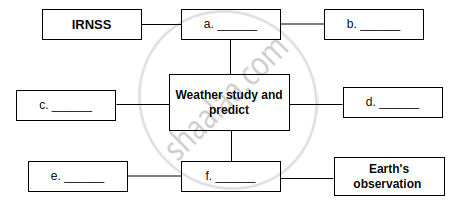
Complete the following table.

Solve the problem.
How much time a satellite in an orbit at height 35780 km above earth's surface would take, if the mass of the earth would have been four times its original mass?
If the height of a satellite completing one revolution around the earth in T seconds is h1 meter, then what would be the height of a satellite taking \[2\sqrt{2} T\] seconds for one revolution?
Mahendra and Virat are sitting at a distance of 1 metre from each other. Their masses are 75 kg and 80 kg respectively. What is the gravitational force between them? G = 6.67 x 10⁻¹¹ Nm2/kg2
Name the first artificial satellite sent by Russia in space.
The function of a satellite launcher is based on Newton's second law of motion.
Calculate the critical velocity of the satellite to be located at 35780 km above the surface of earth.
Observe the figure and write the answers.

- Name the outer orbit.
- Which satellites revolve in low earth orbits?
- Which various orbits are given in the figure?
- Give an example of a launch vehicle based on Newton’s third law.
Write functions of Military satellite and Navigational satellite.
Define orbital velocity.
Write a note on orbital velocity
Numerical problem.
Calculate the speed with which a satellite moves if it is at a height of 36,000 km from the Earth’s surface and has an orbital period of 24 hr (Take R = 6370 km) [Hint: Convert hr into seconds before doing calculation]
Numerical problem.
At an orbital height of 400 km, find the orbital period of the satellite.
The orbital velocity of the satellite depends on its ______.
Geostationary satellites are not useful for studies of the polar region.
Calculate the time taken by a satellite for one revolution revolving at a height of 6400 km above the earth's surface with a velocity of 5.6 km/s.
Write the name of small satellite made by a group of students from COEP (College of Engineering, Pune) sent to the space through ISRO in 2016.
Complete the following equations: