Advertisements
Advertisements
प्रश्न
Answer in detail :
Outline the importance of population pyramids in the study of populations.
Advertisements
उत्तर
- Demographers use population pyramids to describe the age and genderwise distribution of the population.
- The Y-axis in the centre of this graph shows age groups, while X-axis shows the population or percentage of the people in specific age groups.
- The lengths of bars show the numbers or percentages of the population.
- The left side of the graph represents the males, while the right side represents the females.
- The base of the graph represents the children's population, while the apex represents the older people.
- The type of age structure has a direct influence on the future of a nation.
- Both extremes, i.e., old-age dependency and young-age dependency, prove to be a severe burden on a country's economy.
- On the other hand, a higher proportion of the working population means a large workforce.
- Population pyramids also tell us about the number of women and men in various age groups of the country.
- The gender distribution in a country is an important demographic characteristic.
संबंधित प्रश्न
Give geographical reasons:
Literacy rate of a country is an indicator of its socio-economic development.
What do you understand by population composition?
Which regions have an unfavorable sex ratio towards women?
What do you mean by an aging population?
Which attribute does not distinguish people?
Study the given graph carefully and answer the following question:
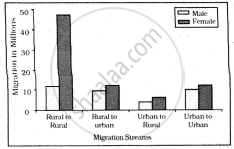
Intra-state Migration by place of Last Residence Indicating Migration Streams India, 2011
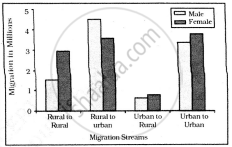
Inter-state Migration by Place of Last Residence Indicating Migration Streams India, 2011
Who dominates rural to rural migration in intra-state migration?
Which one of the following figures represents the wo~king age group of the population? (in years)
The sex ratio in a country can be expressed as which of the following?
Which type of population pyramid usually characterises developed countries where population growth is zero?
Which one of the following is the largest linguistic group of India?
