Advertisements
Advertisements
प्रश्न
Give geographical reason
Less population is engaged in agriculture in developed countries
Advertisements
उत्तर
- The working population takes part in various primary, secondary, tertiary and quaternary occupations.
- The proportion of the working population engaged in various sectors is a good indicator of the levels of economic development of a nation.
- This is because only a developed economy with industries and infrastructure can accommodate more workers in the secondary, tertiary and quaternary sector.
- Only if the economy is still agrarian, then the proportion of people engaged in primary activities is high.
- In developed countries, people prefer jobs in the manufacturing and service sectors rather than in agriculture.
Hence, in develop countries, the percentage of the population engaged in agriculture is low.
संबंधित प्रश्न
What do you mean by an aging population?
Why is sex ratio in some European countries recorded favourable to females? Give one reason.
How many scheduled languages are in our constitution?
How many types of Age-Sex Pyramid?
Which one of the following countries has the highest sex ratio in the world?
Which of the following programs sponsored by the central government aims at enabling the rural population to conserve water for drinking, irrigation, fisheries and afforestation?
Study the given graph carefully and answer the following question:
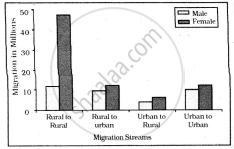
Intra-state Migration by place of Last Residence Indicating Migration Streams India, 2011
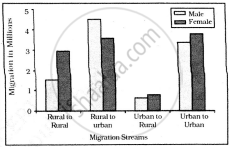
Inter-state Migration by Place of Last Residence Indicating Migration Streams India, 2011
Who dominates rural to rural migration in inter-state migration?
India's population as per the 2011 census is:
Consider the following statements and choose the ones which are correct.
- The world population on an average shows a sex ratio of 102 males per 100 females.
- According to UN, there are only 72 countries that have a favourable sex ratio for females.
- The sex ratio is lowest in Qatar.
What does the high proportion of young population implies?
