Advertisements
Advertisements
प्रश्न
Answer the following question in one or two sentences.
How did Abdul Kalam earn his first wages?
Advertisements
उत्तर
During the Second World War, the newspapers were bundled and thrown out of a moving train. Abdul Kalam earned his first wages by helping his cousin, who distributed newspapers in Rameswaram, to catch these bundles.
संबंधित प्रश्न
Answer of these question in a short paragraph (30–40 words).
Who helped her to continue with music? What did he do and say?
How does Toto come to grandfather’s private zoo?
Answer these question in one or two sentences. (The paragraph numbers within brackets provide clues to the answer.)
Why was the ‘holy man’ who gave Santosh’s mother his blessings surprised?
Based on your reading of the story, answer the following question by choosing the correct options.
The author and his friend Trower fled from the scene as _____
Listen to the poem.
Oh, I wish I'd looked after me teeth,
And spotted the perils beneath.
All the toffees I chewed,
And the sweet sticky food,
Oh, I wish I'd looked after me teeth.
I wish I'd been that much more willin'
When I had more tooth there than fillin'
To pass up gobstoppers.
From respect to me choppers,
And to buy something else with me shillin'.
When I think of the lollies I licked,
And the liquorice all sorts I picked,
Sherbet dabs, big and little,
All that hard peanut brittle,
My conscience gets horribly pricked.
My mother, she told me no end.
'If you got a tooth, you got a friend.'
I was young then, and careless,
My toothbrush was hairless,
I never had much time to spend.
Oh, I showed them the toothpaste all right,
I flashed it about late at night,
But up-and-down brushin'
And pokin' and fussin'
Didn't seem worth time-I could bite!
If I'd known, I was paving the way
To cavities, caps and decay,
The murder of fillin's
Injections and drillin's,
I'd have thrown all me sherbet away.
So I lay in the old dentist's chair,
And I gaze up his nose in despair,
And his drill it do whine,
In these molars of mine.
"Two amalgum," he'll say, "for in there."
How I laughed at my mother's false teeth,
As they foamed in the waters beneath.
But now comes the reckonin'
It's me they are beckonin'
Oh, I wish I'd looked after me teeth.
About the Poet
Pam Ayres (1947- ) is a contemporary writer, a great entertainer who writes and performs
comic verse. She started writing poems and verses as a hobby and has appeared in every
major TV show in the U.K. She has published six books of poems, and cut seven record
albums including a collection of 50 best known poems.
Now, it is your turn. Write and produce your own radio programme. You will need to select your own content. The following are some ideas. You are free, of course, to add your own ideas. Remember, the programme must be in English.
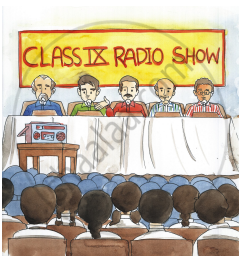
- News stories: about people in your class, about school, about sports (school and local), about the local community
- Comedy: jokes, short plays
- Interviews: with teachers, with exstudents of your school, with a Class IX student who has recently done something very interesting
- Games: general knowledge quiz, panel game, word game
- Advertisements: for shops/industries in the local community, things ‘for sale’ and ‘wanted’ by students
- Local sites: monuments/sites of historical importance and of tourist interest
- Special reports: e.g. safety at school, examination results, school uniform, school assemblies
- Interesting people: role-play interviews with film stars, sports personalities, TV personalities, etc.
- Entertainment reviews: music, films, videos, books, etc.
- Plays
- Songs with lyrics
- Speeches on important personalities
- Tele conference video conference with students, teachers, experts
What does he plant who plants a tree? a
He plants a friend of sun and sky;b
He plants the flag of breezes free;
The shaft of beauty, towering high;
He plants a home to heaven anigh;
For song and mother-croon of bird
In hushed and happy twilight heard____
The treble of heaven's harmony_____
These things he plants who plants a tree.
Read the lines given above and answer the question that follow:
Explain with reference to context.
What does he plant who plants a tree?
He plants, in sap and leaf and wood,
In love of home and loyalty
And far-cast thought of civic good____
His blessing on the neighbourhood,
Who in the hollow of his hand
Holds all the growth of all our land____
A nation's growth from sea to sea
Stirs in his heart who plants a tree.
Read the lines given above and answer the question that follow:
How is the man holding the blessing on his neighborhood in his hand?
The next man looking 'cross the way
Saw one not of his church
And Couldn't bring himself to give
The fire his stick of birch.
The third one sat in tattered clothes.
He gave his coat a hitch.
Why should his log be put to use
To warm the idle rich?
The rich man just sat back and thought
of the wealth he had in store
And how to keep what he had earned
From the lazy shiftless poor.
Read the lines given above and answer the question that follow.
Which is the symbol word used in these lines?
Bangle sellers are we who bear
Our shining loads to the temple fair...
Who will buy these delicate, bright
Rainbow-tinted circles of light?
Lustrous tokens of radiant lives,
For happy daughters and happy wives.
Read the lines given above and answer the question that follow.
What is the tone in this stanza? Quote.
Some are Purple and gold flecked grey
For she who has journeyed through life midway,
Whose hands have cherished , whose love has blest,
And cradled fair sons on her faithful breast,
And serves her household in fruitful pride,
And worship the gods at her husband's side.
Read the lines given above and answer the question that follow:
What in the passage will repel a modern woman?
'All right!' you 'll cry.'All right!' you'll say,
'But if we take the set away,
What shall we do to entertain
Our darling children?Please explain!'
We'll answer this by asking you,
'What used the darling ones to do?
'How used they keep themselves contented
Before this monster was invented?'
Have you forgotten? Don't you know?
We'll say it very loud and slow:
THEY ... USED ... TO ... READ! They'd READ and READ,
AND READ and READ, and then proceed
To READ some more. Great Scott! Gadzooks!
One half their lives was reading books!
The nursery shelves held books galore!
Books cluttered up the nursery floor!
And in the bedroom, by the bed,
More books were waiting to be read!
Read the lines given above and answer the question given below.
According to the poet, what should be done to save children from the hypnotism of television?
The horse was nearly life-size, moulded out of clay, baked, burnt, and brightly coloured, and reared its head proudly, prancing its forelegs in the air and flourishing its tail in a loop; beside the horse stood a warrior with scythelike mustachios, bulging eyes, and aquiline nose. The old image-makers believed in indicating a man of strength by bulging out his eyes and sharpening his moustache tips, and also decorated the man’s chest with beads which looked today like blobs of mud through the ravages of sun and wind and rain (when it came), but Muni would insist that he had known the beads to sparkle like the nine gems at one time in his life.
Read the extract given below and answer the question that follow.
Why had the image makers given the warrior bulging eyes and aquiline nose?
Margot stood alone. She was a very frail girl who looked as if she had been lost in the rain for years and the rain had washed out the blue from her eyes and the red from her mouth and the yellow from her hair. She was an old photograph dusted from an album, whitened away, and if she spoke at all her voice would be a ghost. Now she stood, separate, staring at the rain and the loud wet world beyond the huge glass. “What’re you looking at ?” said William. Margot said nothing. “Speak when you’re spoken to.” He gave her a shove. But she did not move; rather she let herself be moved only by him and nothing else. They edged away from her, they would not look at her. She felt them go away. And this was because she would play no games with them in the echoing tunnels of the underground city. If they tagged her and ran, she stood blinking after them and did not follow. When the class sang songs about happiness and life and games her lips barely moved. Only when they sang about the sun and the summer did her lips move as she watched the drenched windows.
Read the extract given below and answer the question that follow.
What did Margot look like?
Which casket does Arragon finally choose? Whose portrait does he find inside? Which casket actually contains Portia's portrait?
What does mother Warn him?
Multiple Choice Question:
The members of a family act ________
How did the little-bandaged girl make the author much more thoughtful than he ever thought?
Multiple Choice Question:
What are the people always eager to hear?
What is the phrase 'The Century's corpse outleant' in the poem, The Darkling Thrush, a metaphor for?
