Advertisements
Advertisements
प्रश्न
An element E exists in three allotropic forms A, B and C. In allotrope A, the atoms of element E are joined to form spherical molecules. In allotrope B, each atom of element E is surrounded by three other E atoms to form a sheet like structure. In allotrope C, each atom of element E is surrounded by four other E atoms to form a rigid structure.
(a) Name the element E.
(b) What is allotrope A.
(c) What is allotrope B?
(d) What is allotrope C?
(e) Which allotrope is used in making jewellery?
(f) Which allotrope is used in making anode of a dry cell?
Advertisements
उत्तर
(a) Carbon is the element 'E' which exists in three allotropic forms A, B and C.
(b) Buckminsterfullerene is the allotrope, A, of carbon in which the atoms are joined to form spherical molecules.
(c) Graphite is the allotrope, B, of carbon which is surrounded by three other carbon atoms to form a sheet like structure.
(d) Diamond is the allotrope, C, of carbon in which each atom is surrounded by four other carbon atoms to form a rigid structure.
(e) The allotrope C (Diamond) is used to make jewellery.
(f) The allotrope B (Graphite) is used in making anode of a dry cell.
APPEARS IN
संबंधित प्रश्न
State the reason to explain why covalent compounds "have low melting and boiling points."
Explain the bonding in methane molecule using electron dot structure.
What type of bonds are present in hydrogen chloride and oxygen?
will CCl4 conduct electricity or not?
give reason for your choice.
Draw the electron-dot structure of H2O compound and state the type of bonding.
One of the following contains a double bond as well as single bonds. This is:
(a) CO2
(b) O2
(c) C2H4
(d) C2H2
What is the difference between ionic compounds and covalent compounds?
State the type of bonding in the following molecule.
Ammonium ion
Match the pairs.
| Group 'A' | Group 'B' |
| a. C2H6 | 1. Unsaturated hydrocarbon |
| b. C2H2 | 2. Molecular formula of an alcohol |
| c. CH4O | 3. Saturated hydrocarbon |
| d. C3H6 | 4. Triple bond |
Write answer as directed.
What causes the existance of very large number of carbon compound ?
Taking hydrogen chloride and methane as examples, distinguish between a polar covalent bond and a non polar covalent bond.
Give examples for the following:
Two gaseous polar compounds.
Explain the structure of Hydronium ion.
Fill in the blank with correct word from the bracket.
Melting and boiling points of covalent compounds are generally ______ (low, high).
Draw an electron dot diagram to show the formation of the following compound.
Methane
State the type of bond formed when the combining atom has small E.N. difference.
Complete the following activity.
Write the names of the hydrocarbons for the following structural formula.
(isobutylene, cyclohexane, propene, cyclohexene, cyclopentane, benzene, propyne, isobutane, propane)
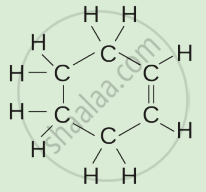 |
Give an example for each of the following statement
A compound in which two Covalent bonds are formed.
