Advertisements
Advertisements
प्रश्न
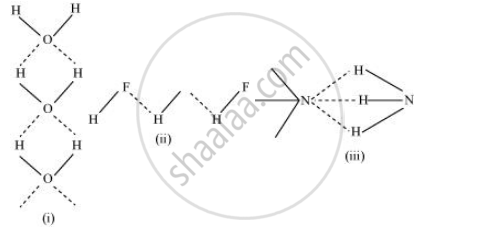
Among NH3, H2O and HF, which would you expect to have highest magnitude of hydrogen bonding and why?
Advertisements
उत्तर
The extent of hydrogen bonding depends upon electronegativity and the number of hydrogen atoms available for bonding. Among nitrogen, fluorine, and oxygen, the increasing order of their electronegativities are N < O < F.
Hence, the expected order of the extent of hydrogen bonding is HF > H2O > NH3.
But, the actual order is H2O > HF > NH3.
Although fluorine is more electronegative than oxygen, the extent of hydrogen bonding is higher in water. There is a shortage of hydrogens in HF, whereas there are exactly the right numbers of hydrogens in water. As a result, only straight chain bonding takes place. On the other hand, oxygen forms a huge ring-like structure through its high ability of hydrogen bonding.
In case of ammonia, the extent of hydrogen bonding is limited because nitrogen has only one lone pair. Therefore, it cannot satisfy all hydrogens.
संबंधित प्रश्न
Arrange the following:
CaH2, BeH2 and TiH2 in order of increasing electrical conductance.
Describe the usefulness of water in biosphere and biological systems.
State whether the following statement is true or false.
The substance in which a solute dissolves is called a solvent.
Explain the picture in your own words.

Why is the density of seawater more than that of rain water?
Define the following.
Boiling point
Which of the following equations depict the oxidising nature of \[\ce{H2O2}\]?
Give reasons: Lakes freeze from top towards bottom.
Give reasons: Ice floats on water.
\[\ce{H2O2}\] is a better oxidising agent than water. Explain.
Why does water show high boiling point as compared to hydrogen sulphide? Give reasons for your answer.
How will you account for 104.5° bond angle in water?
Pure water boils at ______ °C at one atmospheric pressure.
Water is circulated around the car engine using the ______ pump and the heat is absorbed.
What is the taste of distilled water & boiled water?
Which of the following ion is responsible for the temporary hardness of water?
The density of gold is 19 g/cm3. If 1.9 × 10⁻⁴ g of gold is dispersed in one litre of water to give a sol having spherical gold particles of radius 10 nm, the number of gold particles per mm3 of the sol will be ______ × 106.
