Advertisements
Advertisements
प्रश्न
A student went to study a local pond. In one part of the pond she noticed tadpoles scraping at some pond weed. In another part she saw a water beetle holding a tadpole in its jaws.
(a) Construct a food chain for the pond.
(b) How many links are there in this chain?
Advertisements
उत्तर
Weed→ Tadpole → Water beetle
There are three links in this food chain
APPEARS IN
संबंधित प्रश्न
We do not clean natural ponds or lakes but an aquarium needs to be cleaned regularly. Why is it so ? Explain.
Will the impact of removing all the organisms in a trophic level be different for different trophic levels? Can the organisms of any trophic level be removed without causing any damage to the ecosystem?
Why are plants called producers?
What name has been given to those organisms which break down the complex organic compounds present in dead animals and plants?
What are planktons?
Write down a food chain with five links in it.
In a food chain, the third trophic level is always occupied by :
(a) carnivores
(b) herbivores
(c) decomposers
(d) producers
| The following is a food chain that ends with human: plants → bee → human |
- Explain how plants provide food for bees.
- How do bees provide food for humans?
- How does this food chain differ from a usual food chain involving human such as: plants → goat → human?
- Do you think that the food chain given in this question can really be regarded as a food chain? Explain your answer.
The following is a food chain that ends with human :
Do you think that the food chain given in this question can really be regarded as a food chain? Explain your answer.
Name two predators of snakes in a food web operating in a forest ecosystem.
The surface of water in a lake appears green due to a layer of tiny free-floating organisms X on its surface. The lake water also contains organisms like water beetle, fish and tadpole. The sun shines over the lake water and provides energy for the functioning of this lake ecosystem.
(a) What could organisms X be?
(b) Write a food chain comprising of all the four organisms mentioned.
(c) What is the general name of the food chains like the one written above?
(d) Name (i) secondary consumer (ii) producer (iii) tertiary consumer, and (iv) primary consumer, in the above food chain.
(e) If the tertiary consumer gets 0.2 J of energy from the secondary consumer, then how much energy was radiated by the sun to the producer?
A forest ecosystem having a lot of green plants has some foxes, lions and rabbits in it.
(a) Write a food chain comprising all the four organisms mentioned above.
(b) Name (i) one herbivore, and (ii) two carnivores, in this food chain.
(c) Name the link which is a predator as well as a prey.
(d) Name (i) second trophic level, and (ii) third trophic level.
(e) Which link of this food chain can feed on second trophic level as well as third trophic level, independently?
(f) If the sun provides 1000 J of energy to the plants, then how much energy will be transferred to fox through the food chain.
If 100 J energy is available at the producer level in a food chain then the energy available to the secondary consumer will be ______.
Observe the food web and answer the questions given below:
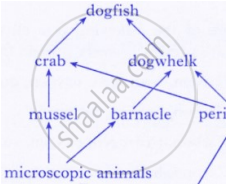
Why do all food chains start with plants?
The food chain begins with the energy given by the ______.
What are autotrophs?
Which group of organisms are not constituents of a food chain?
- Grass, lion, rabbit, wolf
- Plankton, man, fish, grasshopper
- Wolf, grass, snake, tiger
- Frog, snake, eagle, grass, grasshopper
Primary consumers are characterized as:
