Advertisements
Advertisements
प्रश्न
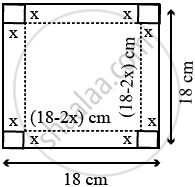
A square piece of tin of side 18 cm is to made into a box without a top by cutting a square from each corner and folding up the flaps to form the box. What should be the side of the square to be cut off so that the volume of the box is the maximum possible?
Advertisements
उत्तर
Let x cm be the length of each side of the square which is to be cut off from each corner of the square tin sheet of side 18 cm.
Let V be the volume of the open box formed by folding up the flaps, then
V = x (18 - 2x) (18 - 2x) = 4x (9 - x)2
= 4 (x3 - 18x2 + 81x)
Differentiate w.r.t.x., we get
`(dV)/dx = 4(3x^2 - 36x + 81) = 12 (x^2 - 12x + 27)`
For maximum / minimum volume
`(dV)/dx = 0`
⇒ 12 (x2 - 12x + 27) = 0
⇒ 12 (x - 3) (x - 9) = 0
⇒ x = 3, 9 but 0 < x < 9
⇒ x = 3
`((d^2V)/dx^2) = 12 (2x - 12) = 24 (x - 6)`
and `((d^2V)/dx^2)_(x=3) = 24 (3 - 6) = -72 <0`
⇒ V has a maximum at x = 3
Hence, the volume of the box is at its maximum when the side of the square to be cut off is 3 cm.
APPEARS IN
संबंधित प्रश्न
Find the local maxima and local minima, if any, of the following function. Find also the local maximum and the local minimum values, as the case may be:
g(x) = x3 − 3x
Find the absolute maximum value and the absolute minimum value of the following function in the given interval:
f (x) = sin x + cos x , x ∈ [0, π]
What is the maximum value of the function sin x + cos x?
Show that the surface area of a closed cuboid with square base and given volume is minimum, when it is a cube.
Find the maximum and minimum of the following functions : y = 5x3 + 2x2 – 3x.
Find the maximum and minimum of the following functions : f(x) = x log x
Find the maximum and minimum of the following functions : f(x) = `logx/x`
Divide the number 20 into two parts such that sum of their squares is minimum.
A wire of length 36 metres is bent in the form of a rectangle. Find its dimensions if the area of the rectangle is maximum.
The perimeter of a triangle is 10 cm. If one of the side is 4 cm. What are the other two sides of the triangle for its maximum area?
The profit function P(x) of a firm, selling x items per day is given by P(x) = (150 – x)x – 1625 . Find the number of items the firm should manufacture to get maximum profit. Find the maximum profit.
Show that among rectangles of given area, the square has least perimeter.
Solve the following : A window is in the form of a rectangle surmounted by a semicircle. If the perimeter be 30 m, find the dimensions so that the greatest possible amount of light may be admitted.
Solve the following:
A wire of length l is cut into two parts. One part is bent into a circle and the other into a square. Show that the sum of the areas of the circle and the square is the least, if the radius of the circle is half of the side of the square.
Solve the following : Show that the altitude of the right circular cone of maximum volume that can be inscribed in a sphere of radius r is `(4r)/(3)`.
A wire of length 120 cm is bent in the form of a rectangle. Find its dimensions if the area of the rectangle is maximum
The sum of the surface areas of a rectangular parallelopiped with sides x, 2x and `x/3` and a sphere is given to be constant. Prove that the sum of their volumes is minimum, if x is equal to three times the radius of the sphere. Also find the minimum value of the sum of their volumes.
Maximum slope of the curve y = –x3 + 3x2 + 9x – 27 is ______.
The maximum value of `["x"("x" − 1) + 1]^(1/3)`, 0 ≤ x ≤ 1 is:
Find the volume of the largest cylinder that can be inscribed in a sphere of radius r cm.
Let f(x) = 1 + 2x2 + 22x4 + …… + 210x20. Then f (x) has ____________.
Range of projectile will be maximum when angle of projectile is
The maximum value of `[x(x - 1) + 1]^(2/3), 0 ≤ x ≤ 1` is
A function f(x) is maximum at x = a when f'(a) > 0.
Let P(h, k) be a point on the curve y = x2 + 7x + 2, nearest to the line, y = 3x – 3. Then the equation of the normal to the curve at P is ______.
If y = alog|x| + bx2 + x has its extremum values at x = –1 and x = 2, then ______.
Check whether the function f : R `rightarrow` R defined by f(x) = x3 + x, has any critical point/s or not ? If yes, then find the point/s.
The rectangle has area of 50 cm2. Complete the following activity to find its dimensions for least perimeter.
Solution: Let x cm and y cm be the length and breadth of a rectangle.
Then its area is xy = 50
∴ `y =50/x`
Perimeter of rectangle `=2(x+y)=2(x+50/x)`
Let f(x) `=2(x+50/x)`
Then f'(x) = `square` and f''(x) = `square`
Now,f'(x) = 0, if x = `square`
But x is not negative.
∴ `x = root(5)(2) "and" f^('')(root(5)(2))=square>0`
∴ by the second derivative test f is minimum at x = `root(5)(2)`
When x = `root(5)(2),y=50/root(5)(2)=root(5)(2)`
∴ `x=root(5)(2) "cm" , y = root(5)(2) "cm"`
Hence, rectangle is a square of side `root(5)(2) "cm"`
Determine the minimum value of the function.
f(x) = 2x3 – 21x2 + 36x – 20
Mrs. Roy designs a window in her son’s study room so that the room gets maximum sunlight. She designs the window in the shape of a rectangle surmounted by an equilateral triangle. If the perimeter of the window is 12 m, find the dimensions of the window that will admit maximum sunlight into the room.

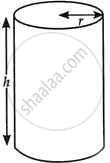
Sumit has bought a closed cylindrical dustbin. The radius of the dustbin is ‘r' cm and height is 'h’ cm. It has a volume of 20π cm3.
- Express ‘h’ in terms of ‘r’, using the given volume.
- Prove that the total surface area of the dustbin is `2πr^2 + (40π)/r`
- Sumit wants to paint the dustbin. The cost of painting the base and top of the dustbin is ₹ 2 per cm2 and the cost of painting the curved side is ₹ 25 per cm2. Find the total cost in terms of ‘r’, for painting the outer surface of the dustbin including the base and top.
- Calculate the minimum cost for painting the dustbin.
The shortest distance between the line y - x = 1and the curve x = y2 is
For a function defined on an interval \[I\], which condition means that \[f\] has a maximum value at \[c\in I\]?
For a function defined on an interval \[I\], which condition means that \[f\] has a minimum value at \[c\in I\]?
Which statement gives the meaning of a local minimum at \[c\]?
What is an absolute maximum?
What is an absolute minimum?
Let \[c\] be a critical point of a continuous function \[f\]. If \[f'(x)\] changes sign from positive to negative as \[x\] passes through \[c\], what is \[c\]?
For \[f(x)=3x^4+4x^3-12x^2+12\], what conclusion follows at \[x=1\]?
