Advertisements
Advertisements
प्रश्न
A refrigerator converts 100 g of water at 20°C to ice at −10°C in 35 minutes. Calculate the average rate of heat extraction in terms of watts.
Given: Specific heat capacity of ice = 2.1 J g−1°C−1
Specific heat capacity of water = 4.2 J g−1°C−1
Specific latent heat of fusion of ice = 336 J g−1
Advertisements
उत्तर
Given: Mass of water, \(m=100\,\text{g}\)
Initial temperature = \(20^\circ\text{C}\)
Final temperature = \(-10^\circ\text{C}\)
Specific heat capacity of water, \(c_w=4.2\,\text{J g}^{-1}\,^\circ\text{C}^{-1}\)
Specific heat capacity of ice, \(c_i=2.1\,\text{J g}^{-1}\,^\circ\text{C}^{-1}\)
Specific latent heat of fusion of ice, \(L=336\,\text{J g}^{-1}\)
Time taken, \(t=35\times60=2100\,\text{s}\)
Heat extracted to cool water from 20°C to 0°C.
\[Q_1=mc_w\Delta T \]
\[=100\times4.2\times20 \]
\[=8400\,\text{J} \]
Heat extracted to convert water at 0°C into ice at 0°C.
\[ Q_2=mL \]
\[ =100\times336 \]
\[ =33600\,\text{J} \]
Heat extracted to cool ice from 0°C to −10°C.
\[ Q_3=mc_i\Delta T \]
\[ =100\times2.1\times10 \]
\[ =2100\,\text{J} \]
Hence, the total heat released.:
Q = Q1 + Q2 + Q3
= 8400 + 33600 + 2100
= 44100 J
Therefore, the average rate of heat extraction.
\[ P=\frac{\text{Total heat extracted}}{\text{Time taken}} \]
= `44100/2100`
= 21 W
संबंधित प्रश्न
Name the S.I. unit of heat.
Explain, why do sandy soils, get heated up quickly as compared to wet soils?
Discuss how high specific heat capacity of water helps in formation of land and sea breeze.
A vessel of negligible heat*capacity contains 40g of ice in it at 0°C, 8g of steam at 100°C is passed into the ice to melt it. Find the final temperature of the contents of the vessel.
(Specific latent heat of vaporization of steam = 2268 J/g, specific latent heat of fusion of ice = 336 J/f and specific heat capacity of water = 4.2 J/g°C)
The SI unit of specific heat is _______.
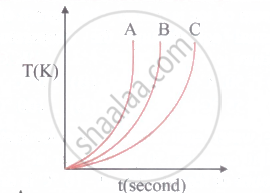
Which of the following substances (A, B and C) has the highest specific heat?