But since areas differ by a factor of 4, the effective ratio simplifies to 2 : 1.
Advertisements
Advertisements
प्रश्न
A point charge is placed at the centre of a hollow conducting sphere of internal radius ‘r’ and outer radius ‘2r’. The ratio of the surface charge density of the inner surface to that of the outer surface will be ______.
रिकाम्या जागा भरा
Advertisements
उत्तर
A point charge is placed at the centre of a hollow conducting sphere of internal radius ‘r’ and outer radius ‘2r’. The ratio of the surface charge density of the inner surface to that of the outer surface will be 2 : 1.
Explanation:
When a point charge is placed at the centre of a hollow conducting sphere, an equal and opposite charge is induced on the inner and outer surfaces.
Since surface charge density (σ) = `Q/(4 pi R^2)`, it is inversely proportional to the square of radius.
Inner radius = r
Outer radius = 2r
`sigma_"inner" : sigma_"outer" = 1/r^2 : 1/((2 r)^2)`
= 4 : 1
shaalaa.com
या प्रश्नात किंवा उत्तरात काही त्रुटी आहे का?
संबंधित प्रश्न
A spherical conductor of radius 12 cm has a charge of 1.6 × 10⁻⁷ C distributed uniformly on its surface. What is the electric field
- inside the sphere
- just outside the sphere
- at a point 18 cm from the centre of the sphere?
A 4 µF capacitor is charged by a 200 V supply. It is then disconnected from the supply and is connected to another uncharged 2 µF capacitors. How much electrostatic energy of the first capacitor is lost in the form of heat and electromagnetic radiation?
The electrostatic force between the metal plates of an isolated parallel plate capacitor C having a charge Q and area A, is ______.
There are two metallic spheres of same radii but one is solid and the other is hollow, then ______.
A conductor carries a certain charge. When it is connected to another uncharged conductor of finite capacity, then the energy of the combined system is ______.
Which of the following statement is true?
Which of the following statements is false for a perfect conductor?
Three Charges 2q, -q and -q lie at vertices of a triangle. The value of E and V at centroid of triangle will be ______.
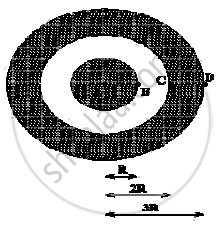
A solid spherical conductor has charge +Q and radius R. It is surrounded by a solid spherical shell with charge -Q, inner radius 2R, and outer radius 3R. Which of the following statements is true?
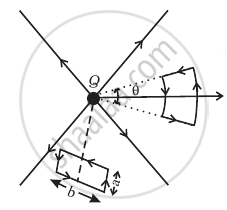
A test charge q is made to move in the electric field of a point charge Q along two different closed paths (Figure). First path has sections along and perpendicular to lines of electric field. Second path is a rectangular loop of the same area as the first loop. How does the work done compare in the two cases?