Advertisements
Advertisements
प्रश्न
A heavy stone is thrown in from a cliff of height h in a given direction. The speed with which it hits the ground
(a) must depend on the speed of projection
(b) must be larger than the speed of projection
(c) must be independent of the speed of projection
(d) may be smaller than the speed of projection.
Advertisements
उत्तर
(a) must depend on the speed of projection
(b) must be larger than the speed of projection
Consider that the stone is projected with initial speed v.
As the stone is falls under the gravitational force, which is a conservative force, the total energy of the stone remains the same at every point during its motion.
From the conservation of energy, we have:
Initial energy of the stone = final energy of the stone
\[ \Rightarrow v_{\text{ max } } = \sqrt{v^2 + 2gh}\]
APPEARS IN
संबंधित प्रश्न
A body is initially at rest. It undergoes one-dimensional motion with constant acceleration. The power delivered to it at time t is proportional to ______.
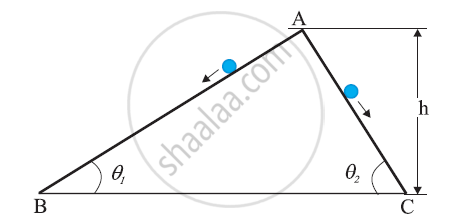
Two inclined frictionless tracks, one gradual and the other steep meet at A from where two stones are allowed to slide down from rest, one on each track . Will the stones reach the bottom at the same time? Will they reach there with the same speed? Explain. Given θ1 = 30°, θ2 = 60°, and h = 10 m, what are the speeds and times taken by the two stones?
A particle is rotated in a vertical circle by connecting it to a string of length l and keeping the other end of the string fixed. The minimum speed of the particle when the string is horizontal for which the particle will complete the circle is
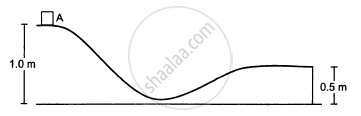
Figure shows a particle sliding on a frictionless track which terminates in a straight horizontal section. If the particle starts slipping from point A, how far away from the track will the particle hit the ground?
A small heavy block is attached to the lower end of a light rod of length l which can be rotated about its clamped upper end. What minimum horizontal velocity should the block be given so that it moves in a complete vertical circle?
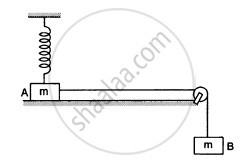
Figure following shows a light rod of length l rigidly attached to a small heavy block at one end and a hook at the other end. The system is released from rest with the rod in a horizontal position. There is a fixed smooth ring at a depth h below the initial position of the hook and the hook gets into the ring as it reaches there. What should be the minimum value of h so that the block moves in a complete circle about the ring?

A spring of negligible mass and force constant 5 Nm–1 is compressed by a distance x = 5 cm. A block of mass 200 g is free to leave the end of the spring. If the system is released, what will be the speed of the block when it leaves the spring?
A particle is released from height S from the surface of the Earth. At a certain height, its kinetic energy is three times its potential energy. The height from the surface of the earth and the speed of the particle at that instant are respectively ______.
A particle is released from height S from the surface of the Earth. At a certain height, its kinetic energy is three times its potential energy. The height from the surface of the earth and the speed of the particle at that instant are respectively ______
Two inclined frictionless tracks, one gradual and the other steep meet at A from where two stones are allowed to slide down from rest, one on each track as shown in figure.
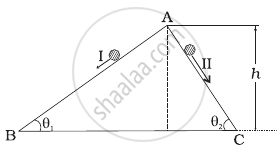
Which of the following statement is correct?
Which of the diagrams shown in figure represents variation of total mechanical energy of a pendulum oscillating in air as function of time?
A mass of 5 kg is moving along a circular path of radius 1 m. If the mass moves with 300 revolutions per minute, its kinetic energy would be ______.
Why is electrical power required at all when the elevator is descending? Why should there be a limit on the number of passengers in this case?
A body falls towards earth in air. Will its total mechanical energy be conserved during the fall? Justify.
A single conservative force acts on a body of mass 1 kg that moves along the x-axis. The potential energy U(x) is given by U (x) = 20 + (x - 2)2, where x is in meters. At x = 5.0 m the particle has a kinetic energy of 20 J, then the maximum kinetic energy of body is ______ J.
A force shown in the F-x graph is applied to a 5 kg cart, which then coasts up a ramp as shown. The maximum height, ymax is ______ m, at which the cart can reach.
(g = 10 m/s2)


