Advertisements
Advertisements
प्रश्न
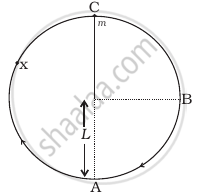
A bob of mass m suspended by a light string of length L is whirled into a vertical circle as shown in figure. What will be the trajectory of the particle if the string is cut at
- Point B?
- Point C?
- Point X?
Advertisements
उत्तर
According to the situation shown above when a bob of mass m is whirled into a vertical circle, the required centripetal force is obtained from the net force towards the center at any point of time in the string. Tension in the string is variable and it is always towards center. But the gravitational force on the bob is always towards center. The speed of the body will be different at different points. So the equations of dynamical equilibrium (Fc = mac, Ft = mat) must be satisfied at all the points. Let when the string makes an angle of 9 with vertical, the speed of mass is v.
Apply Newton’s law perpendicular to the string:
Mg sin = ma, ⇒ a,= g sin
The above equation gives tangential acceleration as a function of the angle. At lowest point = 0° and at highest point = 180°. So at both points sin 9 = 0. Hence a, = 0 at both points L and H.
At point M, = 90°, then a1 = g. It is the maximum value of at
Apply Newton’s law along the string: T – mg cos = mac
or T = mgcos + mv2/r ......(i)
As the body goes up, its velocity will go on decreasing and angle θ will go on increasing. The maximum speed of the body will be at the lowest point L and minimum at the highest point H. Then from the above relation we can find that tension will be maximum at the lowest point and minimum at the highest point.
Tension at the lowest point (θ – 0°, v = vL): TL = `mg + m v_L^2/r` ......(ii)
Tension at the highest point (θ – 180°, v = vH): TH = `mg + m v_H^2/r` ......(iii)

When a string is cut, the tension in string becomes zero and centripetal force is not provided. Hence, the bob tends to move in along the direction of its velocity.
- If the string is cut at any point, then velocity of the body of mass m is along the tangent to the circle. A tangent at point B is vertically downward so the trajectory of the particle is a straight line.
- The tangent at point C is horizontally towards the right.
So the trajectory of the particle is the parabola. - The tangent at point X makes some angle with the horizontal. Again bob will follow a parabolic path with a vertex higher than C.

APPEARS IN
संबंधित प्रश्न
A body is initially at rest. It undergoes one-dimensional motion with constant acceleration. The power delivered to it at time t is proportional to ______.
A heavy stone is thrown from a cliff of height h with a speed v. The stoen will hit the ground with maximum speed if it is thrown
A particle is rotated in a vertical circle by connecting it to a string of length l and keeping the other end of the string fixed. The minimum speed of the particle when the string is horizontal for which the particle will complete the circle is
A heavy stone is thrown in from a cliff of height h in a given direction. The speed with which it hits the ground
(a) must depend on the speed of projection
(b) must be larger than the speed of projection
(c) must be independent of the speed of projection
(d) may be smaller than the speed of projection.
You lift a suitcase from the floor and keep it on a table. The work done by you on the suitcase does not depend on ______.
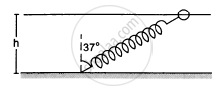
One end of a spring of natural length h and spring constant k is fixed at the ground and the other is fitted with a smooth ring of mass m which is allowed to slide on a horizontal rod fixed at a height h (following figure). Initially, the spring makes an angle of 37° with the vertical when the system is released from rest. Find the speed of the ring when the spring becomes vertical.
A spring of negligible mass and force constant 5 Nm–1 is compressed by a distance x = 5 cm. A block of mass 200 g is free to leave the end of the spring. If the system is released, what will be the speed of the block when it leaves the spring?
A particle is released from height S from the surface of the Earth. At a certain height, its kinetic energy is three times its potential energy. The height from the surface of the earth and the speed of the particle at that instant are respectively ______.
A particle is released from height S from the surface of the Earth. At a certain height, its kinetic energy is three times its potential energy. The height from the surface of the earth and the speed of the particle at that instant are respectively ______
A body is falling freely under the action of gravity alone in vacuum. Which of the following quantities remain constant during the fall?
Two inclined frictionless tracks, one gradual and the other steep meet at A from where two stones are allowed to slide down from rest, one on each track as shown in figure.
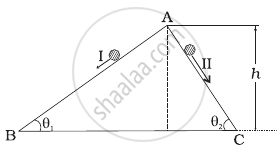
Which of the following statement is correct?
Which of the diagrams shown in figure represents variation of total mechanical energy of a pendulum oscillating in air as function of time?
A mass of 5 kg is moving along a circular path of radius 1 m. If the mass moves with 300 revolutions per minute, its kinetic energy would be ______.
A body falls towards earth in air. Will its total mechanical energy be conserved during the fall? Justify.
A baloon filled with helium rises against gravity increasing its potential energy. The speed of the baloon also increases as it rises. How do you reconcile this with the law of conservation of mechanical energy? You can neglect viscous drag of air and assume that density of air is constant.
