Advertisements
Advertisements
प्रश्न
A heave uniform rod is hanging vertically form a fixed support. It is stretched by its won weight. The diameter of the rod is
पर्याय
smallest at the top and gradually increases down the rod
largest at the top and gradually decreased down the rod
uniform everywhere
maximum in the middle.
Advertisements
उत्तर
As the rod is of uniform mass distribution and stretched by its own weight, the topmost part of the rod experiences maximum stress due to the weight of the entire rod. This stress leads to lateral strain and the rod becomes thinner. Moving down along the length of the rod, the stress decreases because the lower parts bear lesser weight of the rod. With reduced stress, the lateral strain also reduces. Hence, the diameter of the rod gradually increases from top to bottom.
APPEARS IN
संबंधित प्रश्न
A steel cable with a radius of 1.5 cm supports a chairlift at a ski area. If the maximum stress is not to exceed 108 N m–2, what is the maximum load the cable can support?
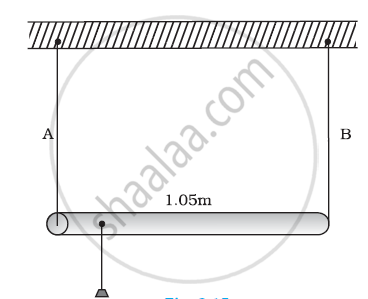
A rod of length 1.05 m having negligible mass is supported at its ends by two wires of steel (wire A) and aluminium (wire B) of equal lengths as shown in Figure. The cross-sectional areas of wires A and B are 1.0 mm2 and 2.0 mm2, respectively. At what point along the rod should a mass m be suspended in order to produce (a) equal stresses and (b) equal strains in both steel and aluminium wires.
A mild steel wire of length 1.0 m and cross-sectional area 0.50 × 10⁻² cm2 is stretched, well within its elastic limit, horizontally between two pillars. A mass of 100 g is suspended from the mid-point of the wire. Calculate the depression at the midpoint.
When a block a mass M is suspended by a long wire of length L, the elastic potential potential energy stored in the wire is `1/2` × stress × strain × volume. Show that it is equal to `1/2` Mgl, where l is the extension. The loss in gravitational potential energy of the mass earth system is Mgl. Where does the remaining `1/2` Mgl energy go ?
When the skeleton of an elephant and the skeleton of a mouse are prepared in the same size, the bones of the elephant are shown thicker than those of the mouse. Explain why the bones of an elephant are thicker than proportionate. The bones are expected to withstand the stress due to the weight of the animal.
A steel blade placed gently on the surface of water floats on it. If the same blade is kept well inside the water, it sinks. Explain.
When some wax is rubbed on a cloth, it becomes waterproof. Explain.
Answer in one sentence.
Define strain.
Answer in one sentence.
How should be a force applied on a body to produce shearing stress?
A spring is stretched by applying a load to its free end. The strain produced in the spring is ______.
A mild steel wire of length 2L and cross-sectional area A is stretched, well within elastic limit, horizontally between two pillars (Figure). A mass m is suspended from the mid point of the wire. Strain in the wire is ______.

Is stress a vector quantity?
The value of tension in a long thin metal wire has been changed from T1 to T2. The lengths of the metal wire at two different values of tension T1 and T2 are l1 and l2 respectively. The actual length of the metal wire is ______.
A steel wire having a radius of 2.0 mm, carrying a load of 4 kg, is hanging from a ceiling. Given that g = 3.1πms-2, what will be the tensile stress that would be developed in the wire?
If 'S' is stress and 'Y' is young's modulus of the material of a wire, the energy stored in the wire per unit volume is ______.
Strain is defined as the ratio of ______.
The SI unit of stress is ______.
