Advertisements
Advertisements
प्रश्न
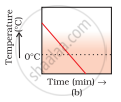
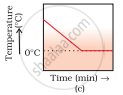
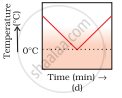
A glass tumbler containing hot water is kept in the freezer compartment of a refrigerator (temperature < 0°C). If you could measure the temperature of the content of the tumbler, which of the following graphs (Fig.1.2) would correctly represent the change in its temperature as a function of time.
पर्याय
Advertisements
उत्तर
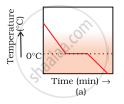
The hot water in the glass tumbler kept in the freezer will first become cold and the temperature will drop till 0°C. At 0°C, water loses heat equal to the latent heat of fusion till entire water freezes to form ice at 0°C. During this change of state from liquid to solid, the temperature remains constant.
On still further cooling, the temperature of ice slowly falls with time. Therefore, the correct option is (a).
APPEARS IN
संबंधित प्रश्न
The fixed temperature at which matter changes state from solid to liquid is called ______.
What are the changes of state in water? Explain.
What is melting? Give example.
Conversion of solid state to liquid state is called fusion; what is meant by latent heat of fusion?
It is a hot summer day, Priyanshi and Ali are wearing cotton and nylon clothes respectively. Who do you think would be more comfortable and why?
A puddle of water gets pooled around the glass of ice cream or a glass of ice cubes. When it is kept at room temperature. Give reason.
Ice does not melt rapidly because of ______.
A change of state is a change of a substance from ______.
The solid, liquid, and phases of water can coexist in equilibrium at ______.
Define latent heat of fusion?
