Advertisements
Advertisements
प्रश्न
A copper wire of diameter 1.6 mm carries a current of 20 A. Find the maximum magnitude of the magnetic field `vecB` due to this current.
Advertisements
उत्तर
Given:
Magnitude of current, I = 20 A
Diameter of the wire, d = 1.6 × 10⁻³ m
∴ Radius of the wire = 0.8 × 10⁻³ m
The magnetic field intensity is given by
\[B = \frac{\mu_0 I}{2\pi r}\]
\[= \frac{2 \times {10}^{- 7} \times 20}{0 . 8 \times {10}^{- 3}} = 5\] mT
APPEARS IN
संबंधित प्रश्न
Using the concept of force between two infinitely long parallel current carrying conductors, define one ampere of current.
The figure shows three infinitely long straight parallel current carrying conductors. Find the
- magnitude and direction of the net magnetic field at point A lying on conductor 1,
- magnetic force on conductor 2.

An electron is moving along the positive x-axis. You want to apply a magnetic field for a short time so that the electron may reverse its direction and move parallel to the negative x-axis. This can be done by applying the magnetic field along
(a) y-axis
(b) z-axis
(c) y-axis only
(d) z-axis only
Two parallel, long wires carry currents i1 and i2 with i1 > i2. When the currents are in the same direction, the magnetic field at a point midway between the wires is 10 µT. If the direction of i2 is reversed, the field becomes 30 µT. The ratio i1/i2 is
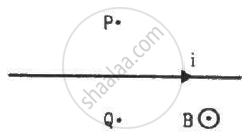
A long, straight wire carrying a current of 1.0 A is placed horizontally in a uniform magnetic field B = 1.0 × 10⁻⁵ T pointing vertically upward figure. Find the magnitude of the resultant magnetic field at the points P and Q, both situated at a distance of 2.0 cm from the wire in the same horizontal plane.
The magnetic field existing in a region is given by `vecB = B_0(1 + x/1)veck` . A square loop of edge l and carrying a current i, is placed with its edges parallel to the x−y axes. Find the magnitude of the net magnetic force experienced by the loop.
A rectangular coil of 100 turns has length 5 cm and width 4 cm. It is placed with its plane parallel to a uniform magnetic field and a current of 2 A is sent through the coil. Find the magnitude of the magnetic field B if the torque acting on the coil is 0.2 N m−1
A long, straight wire carries a current i. Let B1 be the magnetic field at a point P at a distance d from the wire. Consider a section of length l of this wire such that the point P lies on a perpendicular bisector of the section B2 be the magnetic field at this point due to this second only. Find the value of d/l so that B2 differs from B1 by 1%.
A straight, how wire carries a current of 20 A. Another wire carrying equal current is placed parallel to it. If the force acting on a length of 10 cm of the second wire is 2.0 × 10⁻⁵ N, what is the separation between them?
Three coplanar parallel wires, each carrying a current of 10 A along the same direction, are placed with a separation 5.0 cm between the consecutive ones. Find the magnitude of the magnetic force per unit length acting on the wires.
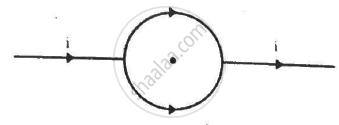
A conducting circular loop of radius a is connected to two long, straight wires. The straight wires carry a current i as shown in figure. Find the magnetic field B at the centre of the loop.
Answer the following question.
Two infinitely long straight wire A1 and A2 carrying currents I and 2I flowing in the same direction are kept' distance apart. Where should a third straight wire A3 carrying current 1.5 I be placed between A1 and A2 so that it experiences no net force due to A1 and A2? Does the net force acting on A3 depend on the current flowing through it?
If a current I is flowing in a straight wire parallel to x-axis and magnetic field is there in the y-axis then, ______.
Do magnetic forces obey Newton’s third law. Verify for two current elements dl1 = dlî located at the origin and dl2 = dlĵ located at (0, R, 0). Both carry current I.
The figure below are two long, parallel wires carrying current in the same direction such that I1 < I2.

- In which direction will wire I1 move?
- If the direction of the current I2 is reversed, in which direction will the wire I1 move now?
The SI unit of the permeability of free space (μ₀) is:
