Advertisements
Advertisements
प्रश्न
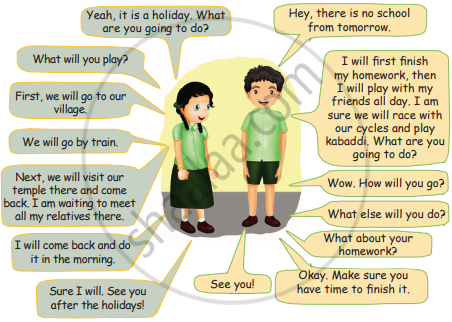
A boy and a girl are talking about their holidays.
Advertisements
उत्तर
| Boy | Hey, there is no school from tomorrow. |
| Girl | Yeah, it is a holiday. What are you going to do? |
| Boy | I will first finish my homework, then I will play with my friends all day. |
| Girl | What will you play? |
| Boy | I am sure we will race with our cycles and play kabaddi. What are you going to do? |
| Girl | First, we will go to our village. |
| Boy | Wow. How will you go? |
| Girl | We will go by train. |
| Boy | What else will you do? |
| Girl | Next, we will visit our temple there and come back. I am waiting to meet all my relatives there. |
| Boy | What about your homework? |
| Girl | I will come back and do it in morning. |
| Boy | Okay. Make sure you have time to finish it. |
| Girl | Sure will. See you after the holidays! |
| Boy | See you! |
APPEARS IN
संबंधित प्रश्न
Form groups and use the following topic for discussion. Take the help of your college library and your teacher.
Dictatorship Vs Democracy
Deliver a short speech for about five minutes on the following.
Imagine what will happen if all the trees in the earth disappear. Discuss with your friends and share it with your classmates.
Last year at this time I ______.
Identify the poetic lines where the following figures of speech are employed and complete the tabular column.
| Figure of speech | Meaning | Lines |
| Synecdoche | A figure of speech in which a part is made to represent the whole or vice versa. e.g. “The Western wave was all a-flame. ” The “Western wave” is a synecdoche as it refers to the sea by the name of one of its parts i.e. wave. |
|
| Paradox |
A figure of speech in which a statement appears to contradict itself. e.g. To bring peace we must war. Be cruel to be kind. |
|
| Onomatopoeia |
A figure of speech wherein the word imitates the sound associated with the object it refers to. e.g. Pitter-patter, pitter-patter Raindrops on my pane. |
|
| Rhetorical Questions |
A figure of speech in the form of a question that is asked to make a point rather than to elicit an answer. e.g. And what is so rare as a day in June? |
I have a robot______ and tall.
Betty bought a bit of butter,
But the bit of butter that Betty bought was bitter.
So Betty bought some better butter,
To make the bitter butter better.
Say the given sentences with different expressions.
- Come and play with me.
- I want to buy things and have fun.
- Come and climb up my trunk and swing from my branches.
- Cut down my trunk.
- I am too old to swing on branches.
- I am too tired to climb.
Is there a bookshop near your home? If there is, do you like to visit it?
Have you ever seen a puppet?
Extend the conversation with two more relevant exchange
| Receptionist | Good evening, sir. Welcome to Chennai. |
| Traveller | I would like to book a deluxe room in your hotel for 3 days. |
| Receptionist | ______ |
| Traveller | ______ |
| Receptionist | ______ |
| Traveller | ______ |
