Advertisements
Advertisements
प्रश्न
A body weighs 450 gf in air and 310 gf when completely immersed in water. Find
(i) The volume of the body,
(ii) The loss in weight of the body, and
(iii) The upthrust on the body.
State the assumption made in part (i).
Advertisements
उत्तर
Weight of body in air = 450 gf
Weight of body in water = 310 gf
(i) Volume of the body = Loss in weight × density of water
= (450 - 310) × 1 [Assumption : density of water = `1 "g cm"^-3`]
= 140 `"cm"^3`
(ii) Loss in weight = Weight of body in air - Weight of body water
= (450 - 310) gf
= 140 gf
(iii) Upthrust on body = loss in weight = 140 gf
APPEARS IN
संबंधित प्रश्न
A body floats in a liquid when its weight becomes equal to the weight of the liquid displaced by its submerged part.
Describe a simple experiment to demonstrate that a liquid enclosed in a vessel exerts pressure in all directions.
The diagram below in Fig. 4.12 shows a device which makes the use of the principle of transmission of pressure.
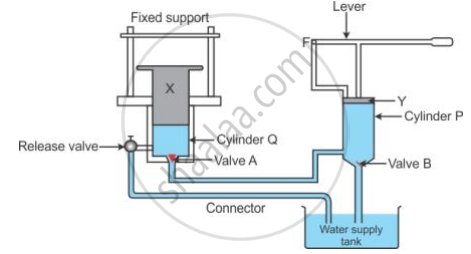
- Name the parts labelled by the letters X and Y.
- Describe what happens to valves A and B and to the quantity of water in the two cylinders when the lever arm is moved down.
- Give reasons for what happens to valves A and B in part (ii).
- What happens when the release valve is opened?
- What happens to valve B in cylinder P when the lever arm is moved up?
- Give a reason for your answer in part (v).
- State one use of the above device.
Complete the following sentence :
Pressure at a depth h in a liquid of density p is ......................
Complete the following sentence :
Pressure of a liquid at a given depth is .................. To the density of the liquid.
Will a body weigh more in air or vacuum when weighed with a spring balance? Give a reason for your answer.
Two spheres A and B, each of volume 100 cm3 is placed on water (density = 1.0 g cm−3). The sphere A is made of wood of density 0.3 g cm−3 and sphere B is made of iron of density 8.9 g cm−3.
- Find:
- The weight of each sphere, and
- The upthrust on each sphere.
- Which sphere will float? Give reason.
Two identical pieces, one of ice (density = 900kg per meter cube) and other wood (density = 300kg per meter cube) float on water.
- Which of the two will have more volume submerged inside water
- Which of two will experience more upthrust due to water.
A beaker contains a liquid of density ‘ρ’ up to height ‘h’ such that ‘PA’ is atmospheric pressure and ‘g’ is the acceleration due to gravity. Answer the following questions:
- What is the pressure on the free surface of the liquid?
- What is the pressure on the base of the beaker?
- What is the lateral pressure at the base on the inner walls of the beaker?
What do you mean by buoyancy?
