Advertisements
Advertisements
प्रश्न
A ball is dropped from a height of 90 m on a floor. At each collision with the floor, the ball loses one tenth of its speed. Plot the speed-time graph of its motion between t = 0 to 12 s.
Advertisements
उत्तर १
Ball is dropped from a height, s = 90 m
Initial velocity of the ball, u = 0
Acceleration, a = g = 9.8 m/s2
Final velocity of the ball = v
From second equation of motion, time (t) taken by the ball to hit the ground can be obtained as:
`s = ut + 1/2 at^2`
`90 = 0 + 1/2 xx 9.8t^2`
`t = sqrt(18.38) = 4.29 s`
From first equation of motion, final velocity is given as:
v = u + at
= 0 + 9.8 × 4.29 = 42.04 m/s
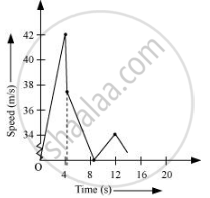
Rebound velocity of the ball, ur = `9/10v = 9/10 xx 42.04 = 37.84 "m/s"`
Time (t) taken by the ball to reach maximum height is obtained with the help of first equation of motion as:
v = ur + at′
0 = 37.84 + (– 9.8) t′
t' = (-37.84)/-9.8 = 3.86 s
Total time taken by the ball = t + t′ = 4.29 + 3.86 = 8.15 s
As the time of ascent is equal to the time of descent, the ball takes 3.86 s to strike back on the floor for the second time.
The velocity with which the ball rebounds from the floor = `9/10xx37.84 = 34.06 "m/s"`
Total time taken by the ball for second rebound = 8.15 + 3.86 = 12.01 s
The speed-time graph of the ball is represented in the given figure as:
उत्तर २
u = 0, a = 10 ms-2, S = 90 m, t = ?, v = ?
Using `v^2 - u^2 = 2as, v^2 - (0)^2 = 2xx10xx90`
=> v = `30sqrt2` "m/s"
Again using `S = ut + 1/2at^2, 90 = 0 xx t + 1/2 xx 10t^2`
`=> t= sqrt18 s = 3sqrt2 s`
Rebound velocity = `9/10 xx 30sqrt2 ms^(-1) = 27sqrt2 ms^(-1)`
Time taken to reach highest point = `(27sqrt2)/10` s = `2.7sqrt2` s
Total time = `(3sqrt2 + 2.7sqrt2)s = 5.7sqrt2 s`
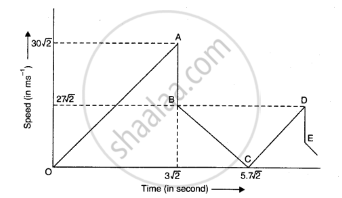
OA represents the vertically downward motion after the ball has been dropped from a height of 90m. The reaches the floor with a velocity of `30sqrt2 ms^(-1)` after having been in motion for `3sqrt2 s`. The verticle straight portion AB represent the loss of 1/10 th of speed, BC represents the vertically upward motion after first rebound. The ball reaches the highest point in `27sqrt2`s. The total time from the beginning is `3sqrt2+2.7sqrt2` i.e `5.7sqrt2` s.
C represent the highest point reached after first rebound. CD represent the vertically downward motion. D represents the situation when the ball again reaches the floor DE represent the loss of speed.
APPEARS IN
संबंधित प्रश्न
The velocity of a particle is towards west at an instant. Its acceleration is not towards west, not towards east, not towards north and towards south. Give an example of this type of motion .
At which point on its path a projectile has the smallest speed?
Two bullets are fired simultaneously, horizontally and with different speeds from the same place. Which bullet will hit he ground first?
A train starts from rest and moves with a constant acceleration of 2.0 m/s2 for half a minute. The brakes are then applied and the train comes to rest in one minute. Find the total distance moved by the train.
A train starts from rest and moves with a constant acceleration of 2.0 m/s2 for half a minute. The brakes are then applied and the train comes to rest in one minute. Find the maximum speed attained by the train .
A train starts from rest and moves with a constant acceleration of 2.0 m/s2 for half a minute. The brakes are then applied and the train comes to rest in one minute. Find the position(s) of the train at half the maximum speed.
A car travelling at 60 km/h overtakes another car travelling at 42 km/h. Assuming each car to be 5.0 m long, find the time taken during the overtake and the total road distance used for the overtake.
A stone is thrown vertically upward with a speed of 28 m/s. change if the initial speed is more than 28 m/s such as 40 m/s or 80 m/s ?
A ball is dropped from a height. If it takes 0.200 s to cross the last 6.00 m before hitting the ground, find the height from which it was dropped. Take g = 10 m/s2.
A ball is thrown horizontally from a point 100 m above the ground with a speed of 20 m/s. Find the time it takes to reach the ground .
A ball is thrown horizontally from a point 100 m above the ground with a speed of 20 m/s. Find the horizontal distance it travels before reaching the ground .
A ball is thrown at a speed of 40 m/s at an angle of 60° with the horizontal. Find the maximum height reached .
A ball is thrown at a speed of 40 m/s at an angle of 60° with the horizontal. Find the range of the ball. Take g = 10 m/s2.
In a soccer practice session the football is kept at the centre of the filed 40 yards from the 10 ft high goalposts. A goal is attempted by kicking the football at a speed of 64 ft/s at an angle of 45° to the horizontal. Will the ball reach the goal post?
A popular game in Indian villages is goli which is played with small glass balls called golis. The goli of one player is situated at a distance of 2.0 m from the goli of the second player. This second player has to project his goli by keeping the thumb of the left hand at the place of his goli, holding the goli between his two middle fingers and making the throw. If the projected goli hits the goli of the first player, the second player wins. If the height from which the goli is projected is 19.6 cm from the ground and the goli is to be projected horizontally, with what speed should it be projected so that it directly hits the stationery goli without falling on the ground earlier?
A bomb is dropped from a plane flying horizontally with uniform speed. Show that the bomb will explode vertically below the plane. Is the statement true if the plane flies with uniform speed but not horizontally?
A person is standing on a truck moving with a constant velocity of 14.7 m/s on a horizontal road. The man throws a ball in such a way that it returns to the truck after the truck has moved 58.8 m. Find the speed and the angle of projection as seen from the road.
Consider the situation of the previous problem. The man has to reach the other shore at the point directly opposite to his starting point. If he reaches the other shore somewhere else, he has to walk down to this point. Find the minimum distance that he has to walk.
A man is standing on top of a building 100 m high. He throws two balls vertically, one at t = 0 and other after a time interval (less than 2 seconds). The later ball is thrown at a velocity of half the first. The vertical gap between first and second ball is +15 m at t = 2 s. The gap is found to remain constant. Calculate the velocity with which the balls were thrown and the exact time interval between their throw.
