Advertisements
Advertisements
प्रश्न
(–4)–4 × (4)–1 = (4)5
पर्याय
True
False
Advertisements
उत्तर
This statement is False.
Explanation:
LHS = (–4)–4 × (4)–1
Using law of exponents,
am × an = (a)m + n ...[∵ a is non-zero integer]
∴ (–4)–4 × (4)–1 = (4)–4 × (4)–1
= (4)–4 – 1
= (4)–5
LHS ≠ RHS
APPEARS IN
संबंधित प्रश्न
Simplify and write the answer in the exponential form.
`1/8 xx (3)^(-3)`
`[(2/13)^-6 ÷ (2/13)^3]^3 xx (2/13)^-9` = ______.
On dividing 85 by ______ we get 8.
By solving (60 – 70) × (60 + 70) we get ______.
The expression for 35 with a negative exponent is ______.
The expontential form for `(-2)^4 xx (5/2)^4` is 54.
Find the value of x so that (–2)3 × (–2)–6 = (–2)2x – 1
A new born bear weighs 4 kg. How many kilograms might a five year old bear weigh if its weight increases by the power of 2 in 5 years?
Supply the missing information for diagram.
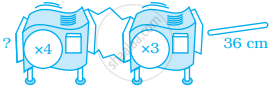
Simplify:
`(1/5)^45 xx (1/5)^-60 - (1/5)^(+28) xx (1/5)^-43`
